
Search
Remove Ads
Advertisement

 This answer was generated by
 Search Results
Image
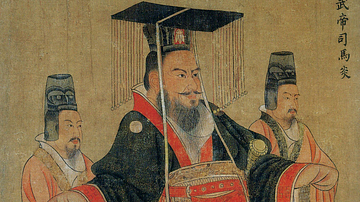
Emperor Wu of Jin
Sima Yan, convinced Cao Huan to abdicate in his favor and then founded the Jin Dynasty in 266 CE, taking the throne name of Emperor Wu of Jin.
Thirteen Emperors Scroll, Boston Museum of Fine Arts

Definition
Jurchen Jin Dynasty
The Jurchen Jin dynasty (meaning “Golden”) ruled parts of China, Mongolia, and northern Korea from 1115 to 1234 CE. The Jurchen originated from Manchuria, but in conquering the neighbouring Liao empire of the Khitan and parts...

Definition
Genghis Khan
Genghis Khan (aka Chinggis Khan) was the founder of the Mongol Empire which he ruled from 1206 until his death in 1227. Born Temujin, he acquired the title of Genghis Khan, likely meaning 'universal ruler’, after unifying the Mongol...

Article
War of the Eight Princes
The War of the Eight Princes (291-306 CE) is the conflict which weakened and finally ended the Western Jin Dynasty (266-316 CE) in China and resulted in more far-reaching consequences throughout the country. The power of...

Definition
Chinese Emperor
The emperors of ancient China had tremendous power and responsibility. Called the 'Son of Heaven', he (and once she) was given a divine right to rule over all people but was expected to promote their best interest and not his...

Article
The Mandate of Heaven and The Yellow Turban Rebellion
Throughout history, in order for a government to be respected and obeyed, it must possess some form of legitimacy recognized by the governed. Governmental systems have relied on a number of models...

Definition
Song Dynasty
The Song (aka Sung) dynasty ruled China from 960 to 1279 CE with the reign split into two periods: the Northern Song (960-1125 CE) and Southern Song (1125-1279 CE). The Northern Song ruled a largely united China from their capital...

Definition
Byzantine Emperor
The Byzantine Emperor ruled as an absolute monarch in an institution which lasted from the 4th to 15th century CE. Aided by ministers, high-ranking nobility, and key church figures, the emperor (and sometimes empress) was commander-in-chief...

Definition
Ögedei Khan
Ogedei Khan (aka Ogodei) ruled the Mongol Empire from 1229 to 1241. He was the third son of Genghis Khan (r. 1206-1227), the empire's founder. Ogedei's accomplishments included creating a new capital at Karakorum, establishing a system...

Definition
Emperor of Japan
The emperor of Japan is a position as the head of state which traditionally dates back to the 7th century BCE and the legendary figure of Emperor Jimmu (r. 660-585 BCE). Emperors came to be known as the Tenno or 'heavenly sovereign'...
