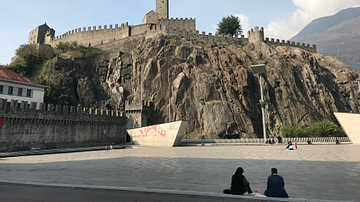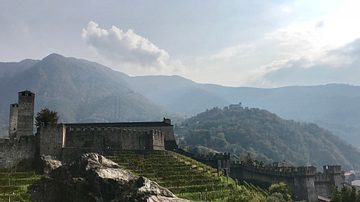


The Castles of Bellinzona are a set of three medieval fortifications located in and surrounding the city of Bellinzona, which is located in Canton Ticino, Switzerland. These castles are the only remaining examples in the Alpine region of heavy military architecture, which date from the late Middle Ages. The castles not only guarded the town of Bellinzona, but also the strategic alpine passes that run through the city before entering the Plain of Lombardy: the St. Gotthard Pass, the Nufenen Pass, the Lukmanier Pass, and the St. Bernard Passes. The three castles were of special importance to the Duchy of Milan, which was ruled by the Visconti (1277-1447) and Sforza dynasties (1450-1535), in the Late Middle Ages and Renaissance until they were taken by the Swiss in 1500. Surviving a massive flood in 1515, the castles became the property of Canton Ticino in 1803. UNESCO declared the three castles - Castelgrande, Montebello, and Sasso Corbaro - and their respective defensive walls as a single World Heritage Site in 2000.
Geography & Early History
Bellinzona is situated east of the Ticino River, lying directly at the foot of the Lepontine Alps. To Bellinzona's south, lies the fertile Po River Valley and the city of Milan, while to the north, lies the high alpine passes of St. Gotthard Nufenen, Lukmanier, and St. Bernard. The Ticino River flows into Lake Maggiore, allowing further access to what is now present-day Italy. The city's topography is perfectly suited for the construction of strategic fortresses as a rocky hillside encompasses the entire eastern flank of the valley in which Bellinzona sits.
There is ample evidence of early human settlement and inhabitation in and around Bellinzona. Archaeologists have found scattered burial sites and the remains of isolated, primitive structures dating back to the Neolithic Period (the 4th millennium BCE), and humans repeatedly occupied the site where Castelgrande now rests during the Neolithic, Bronze Age, and Iron Age. Emperor Augustus (r. 27 BCE - 14 CE) brought what is now the Swiss Canton of Ticino into the Roman Empire as a result of successful military campaigns against the Celts, and the Romans set up a basecamp on what is now Castelgrande around 1 CE. This camp was refortified and greatly expanded through the construction of a large wall and a gate at some point during the 4th century CE. During this era, Roman emperors consolidated their control over the region through the construction of interlinked military fortresses and walls. It is believed by archaeologists that this enlarged military camp in Bellinzona housed about 1000 soldiers during its heyday.
Following the collapse of the Western Roman Empire in the 5th century, the Ostrogoths moved into the region, taking control of the old Roman fortresses and Alpine passes. The Ostrogoths - and later the Lombards - reinforced the older structures, and they successfully defeated the Alemanni in 475 at the Battle of Campi Canini, which is near the present-day village of Arbedo, just to Bellinzona's north. In the 6th century, the Lombards repelled periodic Frankish and Alemannic raids and imposed their sovereignty in the region by allying themselves with the powerful ecclesiastical elite in Milan and Rome. The nearly inviolable fortress at Castelgrande and the well-built Roman walls were of considerable importance to the Lombard kings, as they permitted them not only to exert political and military control over the region but also to control the flow of traffic through the Alps.

Archaeological research shows that the transition from Lombard to Carolingian rule at Castelgrande was not disruptive. Although there is evidence of a fire around 800, it is likely that this was not caused by strife or a battle. Otto the Great opened the St. Bernard and Lukmanier Passes as part of his imperial policies in Italy, and Bellinzona is mentioned for the first time in documents as an administrative district in the 10th century. The Investiture Conflict made Bellinzona and its fortresses highly desirable by both the Guelph and Ghibelline factions. (Emperor Frederick I Barbarossa passed through Bellinzona several times during his travels to Italy in the 12th century.) The Investiture Conflict continued on into the 14th century as a set of protracted political conflicts between local elites and transregional rulers.
Bellinzona was besieged in 1284, 1292, and 1303, as the Rusca family of Como fought against the Visconti family of Milan. It is most probable that Montebello's construction began during this time of internecine warfare. In 1335, the Ruscas lost control of the Italian city of Como and in 1340, they surrendered Castelgrande to the Visconti. The Milanese, however, were impressed with the tenacity of the Ruscas, and the family was permitted to retain control of the small Montebello Castle, which lies on a hill 90 m (300 ft) above Bellinzona and within sight of Castlegrande.
Castles under Milanese Rule
Bellinzona flourished as a city under the rule of the Visconti and Sforza dynasties, who secured the Alpine passes, upheld customs laws, and balanced state finances and ordinances. Interalpine traffic increased tremendously, enriching the ducal family in Milan as well as the regions of Lombardy, Ticino, and the central Swiss Cantons of Uri, Obwalden, and Schwyz. Despite a brief interlude of Swiss control from 1402-1422 by the noble House of Sax (Italian: Sacco) and the Cantons of Uri and Obwalden following the death of Duke Gian Galeazzo Visconti of Milan (r. 1395-1402), the Milanese retook the city and control over its castles following the Battle of Arbedo in 1422. Nonetheless, it was during this Swiss occupation in the 15th century that construction began for a third castle - Sasso Corbaro. This castle is located on a hillside to Bellinzona's east, with views of both the Castlegrande and Montebello castles. When the Milanese retook control of Bellinzona, they completed this castle's construction in only six month's time.

The Milanese regularly reinforced the Castlegrande and Montebello castles throughout the 15th century. They also rebuilt the Murata - the walls located on the west side of Castelgrande - in addition to reinforcing the city's walls. Although the Swiss attempted to take Bellinzona and Ticino again in 1449 (Battle of Castione), 1478 (Battle of Giornico), and 1487 (Battle of Crevola), they were unable to do so as a result of the superior engineering and military prowess of the Milanese. The castles' present design and silhouette reflect the indelible Milanese imprint on Bellinzona.
Swiss in Bellinzona & Modern Times
The Italian Wars (1494-1559) involved both the Duchy of Milan as well as the Swiss Confederation. King Louis XII of France (r. 1498-1515) claimed the duchy of Milan by virtue of being the grandson of Valentina Visconti, taking the city and the entire duchy by force of arms in 1499. While initially promising the Swiss Confederation the city and castles of Bellinzona as a concession in return to the services rendered by Swiss mercenaries in the French army, Louis XII did not keep his word, and French forces occupied the castles in the winter of 1499-1500. In 1500, the citizens of Bellinzona requested aid from the Swiss Cantons of Uri, Schwyz, and Nidwalden to rid themselves of the despised French. Their appeal was heard and the Swiss removed the French army from Bellinzona. Successive treaties between the French and the Swiss Confederation in 1503 and 1516 recognized Swiss claims to Bellinzona and Ticino, and the city and its castles have remained under Swiss control for over 500 years now.
The Swiss Confederation chose a policy of strict neutrality after its devastating defeat by the French at the Battle of Marignano in 1515, and over the ensuing centuries, Bellinzona's castles gradually lost their strategic importance. A severe flood of the Ticino River in 1515 - the “Buzza di Biasca” - destroyed part of Castlegrande's Murata, but this was quickly repaired. Each of the three castles was occupied by the three victorious Swiss cantons, and the Swiss maintained garrisons of roughly 80 men at each castle. By the middle of the 19th century, all three castles were in a state of disrepair, and the Canton of Ticino tried to sell the Castlegrande in 1881. The first of a series of continuous restorations began just after 1900, and intensive efforts lasted from 1920-1955. Archaeological and restoration work continues at the castles to this day.