
Search
Remove Ads
Advertisement

 This answer was generated by
 Search Results

Definition
Gaya
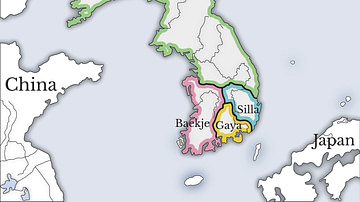
Gaya (aka Kaya or Karak) was a confederation which ruled central-southern Korea during the Three Kingdoms period from the 1st to 6th century CE. The peninsula was dominated by Gaya's more powerful neighbouring kingdoms of Goguryeo (Koguryo...

Video
Bodh Gaya: Center of the Buddhist World
Learn about Bodh Gaya, one of several sights in India associated with the birth of Buddhism.
Definition
Three Kingdoms Period in Korea
The Three Kingdoms Period of ancient Korea (57 BCE – 668 CE) is so-called because it was dominated by the three kingdoms of Baekje (Paekche), Goguryeo (Koguryo), and Silla. There was also, though, a fourth entity, the Gaya (Kaya) confederation...

Article
Ancient Korean & Japanese Relations
Ancient East Asia was dominated by the three states known today as China, Japan, and Korea. These kingdoms traded raw materials and high-quality manufactured goods, exchanged cultural ideas and practices, and fought each other in equal measure...

Definition
Ancient Korea
Korea, located on a large peninsula on the eastern coast of the Asian mainland, has been inhabited since Neolithic times. The first recognisable political state was Gojoseon in the second half of the first millennium BCE. From the 1st century...
Image
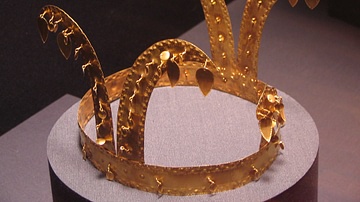
Gold Gaya Crown
A gold crown from the Gaya confederacy, 42-532 CE, southern Korea. (National Museum of Korea, Seoul, South Korea)
Image
Gaya Iron Helmet
An iron helmet from the Gaya confederacy (42-532 CE), Korea. 5th-6th century CE. (National Museum of Korea, Seoul, South Korea)

Definition
Silla
The Silla kingdom ruled south-eastern Korea during the Three Kingdoms period from the 1st century BCE to 7th century CE. The capital was Geumseong (Gyeongju) with a centralised government and hierarchical system of social ranks. The prosperity...

Article
Ancient Korean & Chinese Relations
Contact between Korea and China goes back to mythology and prehistory. Trade developed from the Bronze and Iron Ages with raw materials and manufactured goods going in both directions for centuries thereafter. In addition to traders, migrants...

Article
Ancient Persian Gods, Heroes, and Creatures - The Complete List
The term 'mythology' comes from the Greek mythos (story-of-the-people) and logos (word or speech), meaning the spoken story of a people. Every civilization of the ancient world developed a belief system, which is characterized as 'mythology'...
