
Search Images
Browse Content (p. 672)
Image
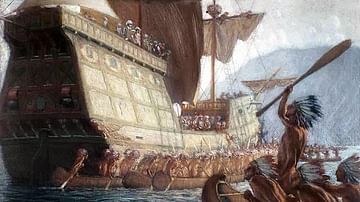
Samuel de Champlain arrives to Quebec
A painting from 1909 portraying the arrival of Samuel de Champlain, the father of New France, on the site of Quebec City. Samuel de Champlain (c. 1567-1635) was a French explorer who made multiple trips across the Atlantic Ocean. He founded...
Image
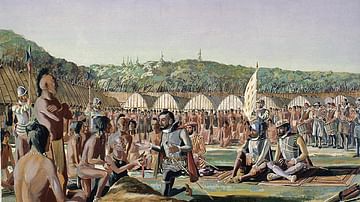
Jacques Cartier a Hochelaga
A watercolour from 1933 showing Jacques Cartier visiting the village of Hochelaga on 3 October 1535. Hochelaga was an Iroquoian fortified village located on or near Mount Royal in present-day Montreal, Quebec. Arriving in 1535, Cartier was...
Image
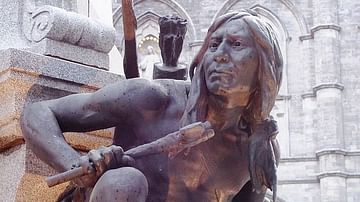
Iroquois Monument Maisonneuve
The Maisonneuve Monument is a monument of an Iroquois by sculptor Louis-Philippe Hébert built in 1895 in Place d'Armes in Montreal.
Image
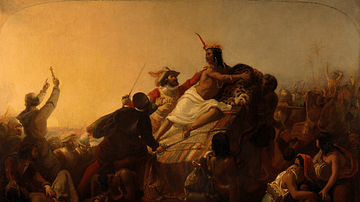
The Capture of Atahualpa
A painting portraying the capture of Atahualpa (r. 1532-33), the Inca emperor, by the Spanish conquistador and adventurer Francisco Pizarro on 16 November 1532. This capture was considered to be the first step of the long conquest of the...
Image
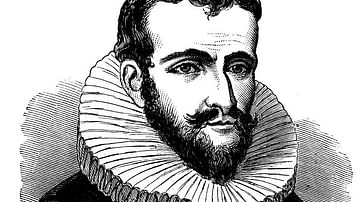
Henry Hudson Portrait
A speculative portrait of Henry Hudson (c. 1565 -1611 CE) that was made around 1885. Hudson was an English sea navigator who explored areas of present-day Canada and parts of the modern New York metropolitan area. He was working for the Dutch...
Image
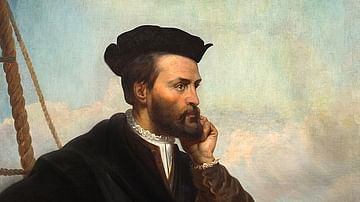
Jaques Cartier
A portrait of Jaques Cartier (1491-1557 CE) a French-Breton maritime explorer. He was the first European who mapped the Gulf of Saint Lawrence and the shores of the Saint Lawrence River. He was also the one who named these lands "The Country...

Image
Map of the Urnfield Culture c. 1300 BCE
This map illustrates the spread of the Urnfield culture in Europe by around 1300 BCE, a late Bronze Age archaeological horizon named for the practice of cremating the dead and placing their ashes in urns buried in fields. Lasting from roughly...

Image
Map of the The Hallstatt Culture
A map illustrating the spread of the Hallstatt culture, a predominant European Late Bronze and Early Iron Age culture from the 12th to 5th centuries BCE. It is generally accepted as a proto-Celtic culture. It is named after Hallstatt, an...
Image
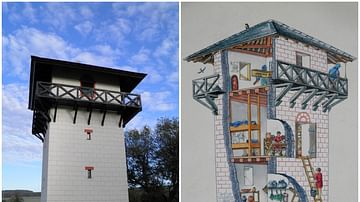
Reconstructed Limes Watchtower Wp 3/26
A 13 metre (42 ft) high Limes stone tower replica (Wp 3/26) near the half-timbered town of Idstein (Hesse, Germany) was constructed in 2001 based on current research. In the 2nd and 3rd centuries CE, the Romans soldiers used retractable ladders...
Image
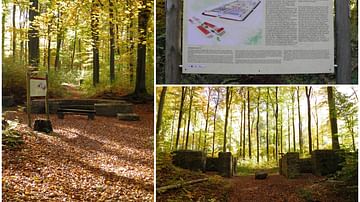
Holzhausen Roman Limes Fort, Germany
The Roman Limes fort at Holzhausen in Rhineland-Palatinate (Germany) is one of the best-preserved forts. It was erected in the mid-3rd century CE during the reign of Caracalla (r. 211-217 CE) and used until the abandonment of the limes in...
