
Search Images
Browse Content (p. 595)

Image
The Three Orders
The Third Estate of France carrying the other two orders (Clergy and Nobility) on its back, engraving with the initials M. P., Paris, 1789.
Bibliothèque nationale de France, Paris.

Image
Frank Holt
Image of Frank Holt, the author of When Money Talks: A History of Coins and Numismatics.

Image
When Money Talks: A History of Coins and Numismatics
When Money Talks: A History of Coins and Numismatics by Frank Holt.
Image
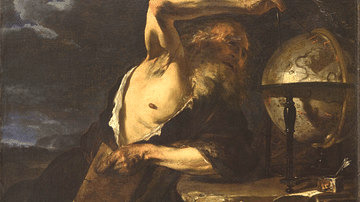
Anaxagoras by Langetti
A 17th-century portrait by Giovanni Battista Langetti of Anaxagoras (l. c. 500-c. 428 BCE), the Pre-Socratic Greek philosopher who claimed the First Cause of existence was Mind (nous). (Philadelphia Museum of Art, USA)

Image
Anaxagoras by de Ribera
A 17th-century portrait by Jusepe de Ribera of Anaxagoras (l. c. 500-c. 428 BCE), the Pre-Socratic Greek philosopher who claimed the First Cause of existence was Mind (nous). (Private Collection)
Image
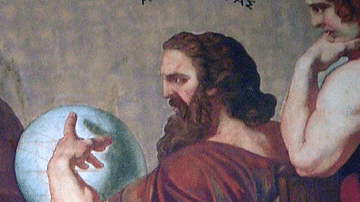
Anaxagoras
A detail of a 19th-century fresco showing Anaxagoras (l. c. 500-c. 428 BCE), the Pre-Socratic Greek philosopher who claimed the First Cause of existence was Mind (nous). By Eduard Lebiedzki, after a design by Carl Rahl. (National and Kapodistrian...
Image
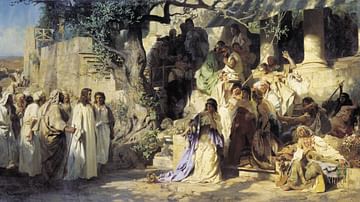
Christ and Sinner
Christ and Sinner, painting by Henryk Siemiradzki, 1873.
Russian Museum, Saint Petersburg.
Image
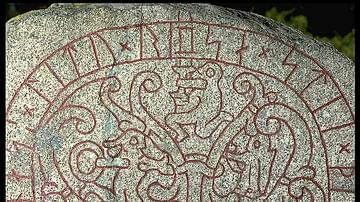
Drävle Runestone
Drävle Runestone, showing Andvari's ring, the Andvaranaut.
Sweden, Enköping Municipality, Altuna parish.

Image
Ring with Runic Inscription
Gold finger-ring, engraved with a runic inscription, three letters continuing on inside of the hoop, found near Carlisle, England, dated to the 8th-10th century.
The British Museum, London

Image
Map of the Late Bronze Age Collapse c. 1200 - 1150 BCE
The Late Bronze Age Collapse (c. 1200–1150 BCE) marks a period of profound political and economic breakdown across the Aegean, Eastern Mediterranean, Anatolia, and Mesopotamia. Highly interconnected palace-based societies, dependent on centralized...
