
Search Images
Browse Content (p. 1921)
Image
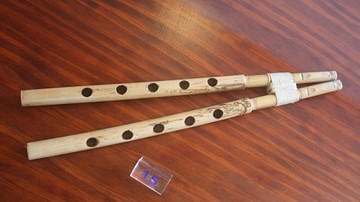
Greek Double Aulos
The ancient Greek double aulos (diaulos) consisted of two pipes (auloi) attached at the mouthpiece and sometimes held in place with a leather strap (forveia) to the player's face. The pipes could be of equal length or unequal...
Image
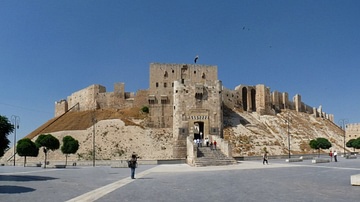
Citadel of Aleppo
The Citadel of Aleppo (Arabic: قلعة حلب) is a large medieval fortified palace in the centre of the old city of Aleppo, northern Syria. It is considered to be one of the oldest and largest castles in the world. Usage of the Citadel...

Image
Artemis / Diana
Statue of Artemis (Greek) or Diana (Roman), known as Diane de Versailles, France. Roman copy, 1st or 2nd century CE, of lost Greek bronze attributed to Leochares, c. 325 BCE. Musee du Louvre, Paris.
Image
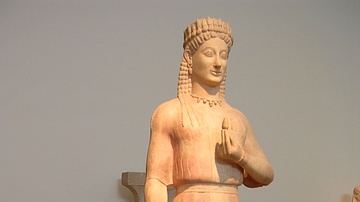
Kore
Kore from the Athenian Acropolis, late 6th century BCE. (National Museum, Athens)
Image
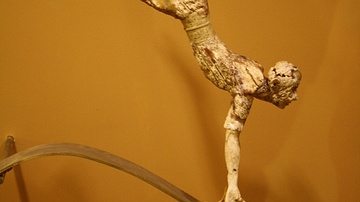
Minoan Bull-Leaper
An ivory figurine representating a bull-leaper from a three dimensional composition (with two other figures and a bull) depicting this Minoan sporting or religious activity. Hair would have been added using bronze wire and clothes...
Image
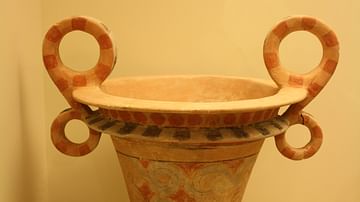
Minoan Vase
Late Minoan polychrome vase, mid-15th century BCE, from Isopata. (Archaeological Museum, Heraklion)

Image
Minoan Woman Fresco, Knossos
A fresco detail from a banquet scene (known as 'La Parisienne') from Knossos, 1400-1350 BCE. The figure, in a robe and with a sacral knot at her neck, is perhaps a priestess. (Archaeological Museum, Heraklion)

Image
Temple of Hephaistos & Athena, Athens
Also known as the Theseum because of its decorative sculpture depicting the feats of Theseus, the Doric temple, built in 449 BCE, is situated in the agora of Athens. Hephaistos and Athena, as gods of crafts were...

Image
Augustus, Bronze Equestrian Statue
Bronze torso from an equestrian statue of Emperor Octavian Augsustus. (National Museum, Athens)

Image
The Clock of Andronicus Cyrrhestes
Also known as the Tower of the Winds because of the relief carvings of the eight winds near its top, this marble tower, built in the first century BCE, contained the clock which ran on water from the Acropolis spring...
