
Search Images
Browse Content (p. 1901)
Image
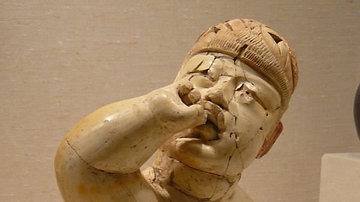
Olmec "Baby" Figurine
A life-size ceramic 'baby' figurine from the Olmec civilization of Mexico, Mesoamerica, 12th-9th century BCE. The significance of these figures, often depicting infantile gestures, is not clear. They may represent deities...

Image
Celtic Parade Helmet
A Celtic parade helmet in bronze and iron covered in gold with coral inlay, c. 350 BCE. Found buried in a cave in Agris, western France. It is a fine example of the use of vegetal motifs in ancient Celtic art. (Bernisches...
Image
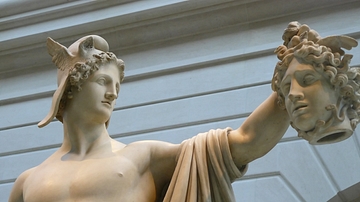
Perseus & Medusa by Canova
A marble statue of the pan-Hellenic hero Perseus wearing the cap of Hades (which rendered the wearer invisible) and holding the head of the Gorgon Medusa. (By Antonio Canova, 1804-6 CE, Metropolitan Museum of Art, New...
Image
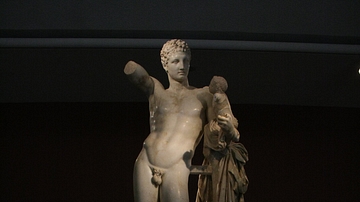
Hermes of Praxiteles
This statue was uncovered during excavations in 1877 at the Temple of Hera at Olympia. The statue captures the myth where Hermes takes the baby Dionysos to the Nymphs, where on his way he rests upon a tree trunk, having thrown...
Image
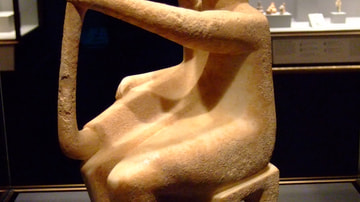
Cycladic Harp Player Figurine
A 28cm high, marble harp player from the Cycladic islands, 2700-2300 BCE. It is one of the earliest representations of a musician from the Bronze Age Aegean. (J.Paul Getty museum, Malibu, USA).

Image
Cycladic Head Sculpture
A marble head from a large Cycladic figure sculpture, 2600-2500 BCE. The head shows traces of pigment on the forehead - probably a diadem - and the nose and cheeks. (J.Paul Getty Museum, Malibu, USA).

Image
Early Cycladic Figurines
Early Cycladic 'violin' figurines in marble, 3200-2800 BCE. The figurines represent a squatting female figure but their exact significance is not known. Most probably they represent a female fertility deity. (National Archaeological...

Image
Cycladic Figurine c. 2400 BCE
A marble figurine from the Cycladic islands, c. 2400 BCE. The posture and incised details are typical of Cycladic sculpture and the swollen belly may suggest pregnancy. The function of the statues is unknown but they...

Image
Hercules Fighting the Centaur Nessos
A statue by Giambologna depicting Hercules fighting the centaur Nessos following the latter's attack on Hercules' wife Deianeira as they crossed the river Evenus. 1599 CE (Loggia dei Lanzi, Florence, Italy).

Image
Mycenaean Stirrup Jar
A Mycenaean terracotta stirrup jar, c. 1200 BCE. The name derives from the resemblance of the handle to a double stirrup. The handle is often decorated with a false spout whilst the true spout is to the side and separate from...
