

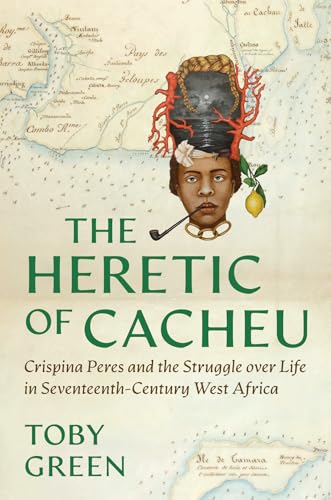
| Rating: | |
|---|---|
| Title: | The Heretic of Cacheu: Crispina Peres and the Struggle over Life in Seventeenth-Century West Africa |
| Author: | Toby Green |
| Audience: | University |
| Difficulty: | Medium |
| Publisher: | University of Chicago Press |
| Published: | 2025 |
| Pages: | 288 |
Toby Green’s "The Heretic of Cacheu: Crispina Peres and the Struggle over Life in Seventeenth-Century West Africa" is a richly detailed and deeply human book centered on the life of Crispina Peres, a powerful African woman trader prosecuted by the Portuguese Inquisition in the 1660s. The book opens a window onto the everyday realities, moral tensions, and global connections of early modern West Africa. The book will be of interest to historians of religion or gender and history enthusiasts.
In The Heretic of Cacheu, Toby Green uses one extraordinary life to illuminate a broader historical landscape shaped by commerce, belief, gender, and cultural negotiation. Cacheu, located in present-day Guinea-Bissau, was a small but vital Atlantic port where African, European, and Afro-Portuguese communities interacted daily. It functioned as a hub linking West Africa to Brazil and the wider Atlantic world. Rather than presenting Cacheu as a peripheral outpost of European expansion, Green shows it to be a dynamic society with its own social hierarchies, customs, and systems of authority. This setting is essential to understanding Crispina Peres, who emerges not as a marginal figure but as a central actor in her community.
Crispina Peres was a wealthy trader involved in the commerce of enslaved people, a fact that the book confronts directly without moral evasion. She was also a Christian who attended church and participated in Catholic rituals while simultaneously drawing on African healing practices and spiritual traditions. Her arrest by the Portuguese Inquisition stemmed from this religious hybridity. When she sought help from African healers during illness, Portuguese authorities interpreted her actions as heresy. What follows is a dramatic story of accusation, imprisonment, exile, and return, reconstructed from fragmentary but revealing archival records.
One of the book’s great strengths is Green’s ability to make the historical record speak beyond the courtroom. The Inquisition documents are not treated simply as legal texts but as windows into everyday life. Through them, readers learn about housing styles, clothing, family relations, medical practices, and social gatherings in seventeenth-century Cacheu. These details give texture to the narrative and make the world Crispina Peres inhabited feel tangible and lived-in.
Green also uses this story to challenge long-standing assumptions about African societies in the early modern period. Rather than portraying Africans as passive victims of European expansion, he emphasizes African agency and adaptability. Women, in particular, play a central role in his account. Crispina Peres and other women in Cacheu controlled property, conducted trade, and exercised significant influence within their communities. This challenges conventional historical narratives that place men and European actors at the center of economic and political life.
Religion is another key theme. The book shows that religious life in Cacheu was not divided neatly between ‘Christian’ and ‘traditional’ beliefs. Instead, people navigated multiple spiritual systems at once, combining Catholic practices with African cosmologies in ways that made sense within their own cultural frameworks. The Inquisition’s attempt to impose rigid definitions of orthodoxy reveals the limits of European authority and the misunderstandings that arose when different worldviews collided.
Although the book is grounded in a single place and person, its scope is global. Green repeatedly situates Cacheu within wider networks of trade and communication that stretched across the Atlantic and beyond. Goods, ideas, and people moved constantly between Africa and the Americas, and developments in one region shaped lives in another. In this way, The Heretic of Cacheu contributes to a growing body of world history that emphasizes connection rather than isolation.
The book does, at times, demand careful reading. The complexity of the social world that Green reconstructs and Green's dense historical detail may feel challenging for some readers. Yet, this effort is rewarded by an intellectually engaging and emotionally resonant narrative. Crispina Peres emerges not as a symbol or abstraction, but as a person navigating uncertainty, power, faith, and survival in a changing world.
The Heretic of Cacheu is a compelling reminder that global history is built from individual lives. By restoring Crispina Peres to the historical record, Toby Green, Professor of Precolonial and Lusophone African history and culture at King’s College, London, shows how much can be learned when historians look closely at places and people long overlooked. The result is a vivid, thought-provoking account that invites general readers to rethink early modern history, not as a story driven solely by European empires, but as one shaped by African actors whose choices mattered profoundly. Because this book has been written in a lucid manner and for more than one type of audience, it will interest historians of religion and gender, history enthusiasts, specialists of precolonial African history, and general readers.
About the Reviewer
Related Content

The Portuguese in East Africa

African Slave Life in Colonial British America

Indian Ocean Trade before the European Conquest
Cite This Work
APA Style
Saghar, A. (2026, March 09). The Heretic of Cacheu: Crispina Peres and the Struggle over Life in Seventeenth-Century West Africa. World History Encyclopedia. https://www.worldhistory.org/review/551/the-heretic-of-cacheu-crispina-peres-and-the-strug/
Chicago Style
Saghar, Amol. "The Heretic of Cacheu: Crispina Peres and the Struggle over Life in Seventeenth-Century West Africa." World History Encyclopedia, March 09, 2026. https://www.worldhistory.org/review/551/the-heretic-of-cacheu-crispina-peres-and-the-strug/.
MLA Style
Saghar, Amol. "The Heretic of Cacheu: Crispina Peres and the Struggle over Life in Seventeenth-Century West Africa." World History Encyclopedia, 09 Mar 2026, https://www.worldhistory.org/review/551/the-heretic-of-cacheu-crispina-peres-and-the-strug/.
