
Search
Did you mean: Oxus?
Remove Ads
Advertisement

 This answer was generated by
 Search Results

Article
The Queen of the Night
The Queen of the Night (also known as the `Burney Relief') is a high relief terracotta plaque of baked clay, measuring 19.4 inches (49.5 cm) high, 14.5 inches (37 cm) wide, with a thickness of 1.8 inches (4.8 cm) depicting a naked winged...

Article
The Mesopotamian Pantheon
The gods of the Mesopotamian region were not uniform in name, power, provenance or status in the hierarchy. Mesopotamian culture varied from region to region and, because of this, Marduk should not be regarded as King of the Gods in the same...

Article
The Invention of the First Coinage in Ancient Lydia
Money may take many forms, from the digital code of cryptocurrency to the woodpecker scalps favoured in early California. People have also used cattle, cacao beans, cowrie shells, chewing gum, grain, and giant stones as money. Early cultures...

Definition
Maya Religion
Maya religious beliefs are formed on the notion that virtually everything in the world contains k'uh, or sacredness. K'uh and k'uhul, similar terms which are used to explain the spirituality of all inanimate and animate things, describe the...

Definition
Ishtar
Ishtar (Inanna in Sumerian sources) is a primary Mesopotamian goddess closely associated with love and war. This powerful Mesopotamian goddess is the first known deity for which we have written evidence. While largely unknown in the modern...

Definition
Teotihuacan
Teotihuacan, located in the Basin of Central Mexico, was the largest, most influential, and most revered city in the history of the New World. It flourished in Mesoamerica's Golden Age, the Classic Period of the first millennium CE. Dominated...
Definition
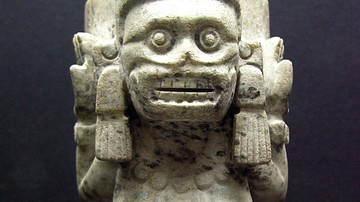
Mictlantecuhtli
Mictlantecuhtli (pron. Mict-lan-te-cuht-li) or 'Lord of the Land of the Dead' was the Aztec god of death. He ruled the underworld (Mictlán) with his wife Mictecacíhuatl. Mictlantecuhtli was worshipped and feared across Mesoamerica. The god...

Definition
Ereshkigal
Ereshkigal (also known as Irkalla and Allatu) is the Mesopotamian Queen of the Dead who rules the underworld. Her name translates as 'Queen of the Great Below' or 'Lady of the Great Place.' She was responsible for both keeping the dead within...
Definition
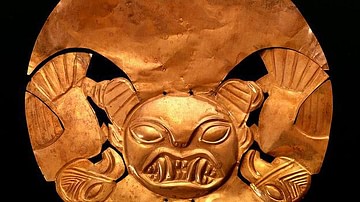
Moche Civilization
The Moche civilization (also known as the Mochica) flourished along the northern coast and valleys of ancient Peru, in particular, in the Chicama and Trujillo Valleys, between 1 CE and 800 CE. The Moche state spread to eventually cover an...
Definition
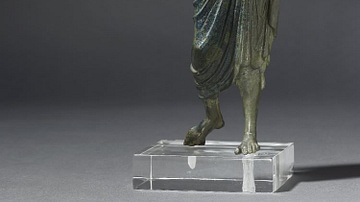
Etruscan Religion
The religion of the Etruscans, the civilization which flourished from the 8th to 3rd century BCE in central Italy, has, like many other features of the culture, long been overshadowed by that of its Greek contemporaries and Roman conquerors...
