


Across nearly two millennia, the city of Rome was repeatedly captured and plundered as its political position changed from the capital of an expanding republic to the symbolic center of an empire and, later, the seat of the papacy. These seven sacks did not represent a single continuous "fall of Rome." Each occurred within a different political and military context and reveals changing patterns of warfare, civil conflict, imperial fragmentation, and competition for control of the city.
- Gauls under Brennus (c. 390 BCE) – after defeating a Roman army at the Battle of the Allia, Gallic forces entered and plundered much of Rome. The young Republic recovered and subsequently strengthened its military position in central Italy.
- Visigoths under Alaric (410) – following failed negotiations with Emperor Honorius, Alaric's Visigoths entered Rome and subjected it to a three-day sack. Physical destruction was relatively limited, but the capture of the former imperial capital caused an enormous psychological shock across the Roman world.
- Vandals under Geiseric (455) – exploiting the political crisis following the murder of Emperor Valentinian III, Vandal forces occupied Rome and carried off wealth and captives during roughly two weeks of systematic plunder, further exposing the weakness of Western imperial government.
- Ricimer's forces during the Civil War (472) – the powerful general Ricimer besieged Emperor Anthemius inside Rome during an internal struggle for control of the Western Roman Empire. Fighting, famine, and plunder devastated parts of the city only four years before the conventional end of the western imperial office.
- Ostrogoths under Totila (546) – during the Gothic War, Totila captured Rome after a prolonged siege that caused severe famine and depopulation. The city changed hands repeatedly between Ostrogothic and Eastern Roman forces before being reoccupied by the Byzantines.
- Normans under Robert Guiscard (1084) – Norman troops entered Rome to rescue Pope Gregory VII from forces supporting Emperor Henry IV. Their subsequent plunder and fires caused extensive destruction and forced the pope to leave the city.
- Imperial troops of Charles V (1527) – largely unpaid and mutinous soldiers of Holy Roman Emperor Charles V stormed Rome, carrying out widespread killing, looting, and destruction. The sack severely weakened papal political authority and became one of the defining crises of Renaissance Italy.
The significance of these sacks changed as Rome itself changed. In 390 BCE the city was the center of a rising regional power; in 410 and 455 it remained the symbolic heart of an empire whose political center had shifted elsewhere; by 1084 and 1527 its importance rested increasingly on the papacy and its religious and cultural prestige. Seen across the long term, the seven sacks therefore provide a striking measure of Rome's transformation, from republican capital to imperial symbol, medieval papal city, and Renaissance center, while demonstrating its remarkable capacity to survive repeated episodes of conquest and destruction.
About the Author
Related Images

Robert Guiscard and Count Roger

Robert Guiscard
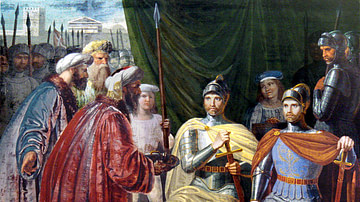
Roger I & Robert Guiscard Receive the Keys to Palermo

Robert Guiscard with Pope Nicholas II

The Court of Robert Guiscard

Map of the Kingdom of the Vandals (435–534 CE)
Cite This Work
APA Style
Netchev, S. (2026, October 14). The Seven Sacks of Rome. World History Encyclopedia. https://www.worldhistory.org/image/21542/the-seven-sacks-of-rome/
Chicago Style
Netchev, Simeon. "The Seven Sacks of Rome." World History Encyclopedia, October 14, 2026. https://www.worldhistory.org/image/21542/the-seven-sacks-of-rome/.
MLA Style
Netchev, Simeon. "The Seven Sacks of Rome." World History Encyclopedia, 14 Oct 2026, https://www.worldhistory.org/image/21542/the-seven-sacks-of-rome/.
