


Pella curse tablet, lead scroll, first half of the 4th century BCE.
Writing and dedicating a curse tablet (katadesmos) was an act of practical magic in the Greco-Roman world. Curse tablets were fragmental sheets of lead—or, in rare instances, gold or silver—with divine appeals written on them summoning the deities associated with the underworld, such as Hades and Persephone, magic (e.g., Hecate), or the liminal transition to the afterlife (e.g., Charon). The content could often be vindictive, as a reaction to emotional or material loss, or preemptive, to prevent an unfavourable event from happening. This well-preserved curse tablet retrieved from the right-hand side of an interred body in the cemetery of Pella falls into the second category. It reads:
Of Thetima and Dionysophon the ritual wedding and the marriage I bind by a written spell, as well as [the marriage] of all other women [to him], both widows and maidens, but above all of Thetima; and I entrust [this spell] to Macron and to the daimones. And were I ever to unfold and read these words again after digging [the tablet] up, only then should Dionysophon marry, not before; may he indeed not take another woman than myself, but let me alone grow old by the side of Dionysophon and no one else. I implore you: have Pity for [Phila?], dear daimones, [for I am indeed bereft?] of all my dear ones and abandoned. But please keep this [piece of writing] for my sake so that these events do not happen and wretched Thetima perishes miserably. … but let me become happy and blessed.
Apart from presenting a nearly complete narrative, the curse tablet from Pella is significant for understanding the cultural identity of the ancient Macedonians. It is composed in a local Doric dialect belonging to the Northwestern Greek Group, which makes it plausible as a piece of solid linguistic evidence of the region’s Hellenic character. The author—likely a woman of non-elite status—thus demonstrates familiarity with the Greek language, which was often associated with the upper classes striving to be recognized as true Hellenes. This suggests that Greek was already widely spoken in Pella at the time. As such, the tablet provides compelling support for the profound and persistent Greek heritage of the Macedonian people.
Archaeological Museum of Pella.
About the Author
Photo Location
This photograph was taken at the following location:
Related Images
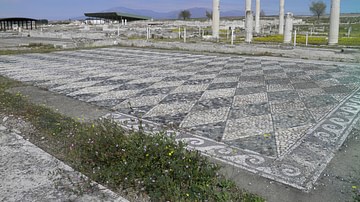
House of Dionysos at Pella, Macedonia
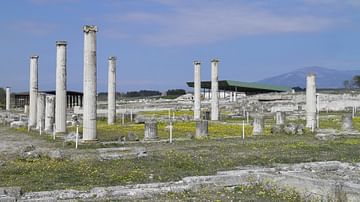
Pella, Macedonia
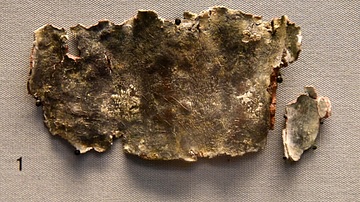
Curse Tablet from Uley

Terracotta Bust of a Noble Maiden from Pella
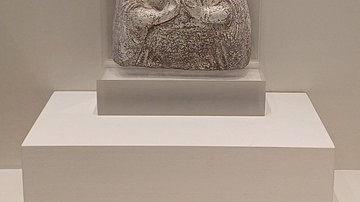
Terracotta Bust of an Underworld Goddess from Pella

Terracotta Bust of a Macedonian Goddess or Princess from Pella
References
- Greg Woolf. "Curse Tablets: The History of a Technology." Greece and Rome, vol. 69, April 2022, pp. 120-134.
- Lamont, Jessica L. In Blood and Ashes. Oxford University Press, 2023.
External Links
Cite This Work
APA Style
Choubineh, N. (2025, October 25). Curse Tablet from Pella, Ancient Kingdom of Macedonia. World History Encyclopedia. https://www.worldhistory.org/image/21229/curse-tablet-from-pella-ancient-kingdom-of-macedon/
Chicago Style
Choubineh, Nathalie. "Curse Tablet from Pella, Ancient Kingdom of Macedonia." World History Encyclopedia, October 25, 2025. https://www.worldhistory.org/image/21229/curse-tablet-from-pella-ancient-kingdom-of-macedon/.
MLA Style
Choubineh, Nathalie. "Curse Tablet from Pella, Ancient Kingdom of Macedonia." World History Encyclopedia, 25 Oct 2025, https://www.worldhistory.org/image/21229/curse-tablet-from-pella-ancient-kingdom-of-macedon/.
