
17th Anniversary Fundraiser
Celebrate our 17th anniversary with a gift to support free history education around the world!


The mid-19th century transformation of Europe was driven above all by the unification of Italy and Germany, which reduced long-standing political fragmentation and introduced powerful new nation-states into an already competitive continental system. In Italy, the kingdom of Piedmont-Sardinia became the nucleus of unification, a process achieved through war, diplomacy, and nationalism between 1859 and 1871 under Victor Emmanuel II (king of Sardinia 1849–1861; king of Italy 1861–1878). In Central Europe, Prussia led the process of German unification through a series of conflicts directed by Otto von Bismarck, culminating in the proclamation of the German Empire in 1871 under Wilhelm I (king of Prussia 1861–1888; German emperor 1871–1888). Together, these developments marked a broader transition from the post-Napoleonic order to an age increasingly defined by nationalism, great-power rivalry, and alliance politics.
This new political landscape was further redefined by the Congress of Berlin (June–July 1878), convened in the aftermath of the Russo-Turkish War (1877–1878). The congress sought to contain Russian influence while preserving a workable balance among the great powers. It recognized the independence of Romania, Serbia, and Montenegro, reduced the size of Bulgaria, and authorized Austria-Hungary to occupy Bosnia and Herzegovina. Although presented as a stabilizing settlement, the Berlin agreements left many national aspirations unresolved and intensified rivalries in the Balkans, contributing to the tensions that would shape late 19th- and early 20th-century European diplomacy.
About the Author
Related Images

Map of the Holy Roman Empire under Otto the Great c. 972

Map of the Scramble for Africa after the Berlin Conference

Map of Odysseus’ 10-year Journey Home

Map of Europe After World War II (1945 to c. 1989)

Map of Europe after the War of the Austrian Succession, 1748 - Dynastic Rivalry and Balance of Power
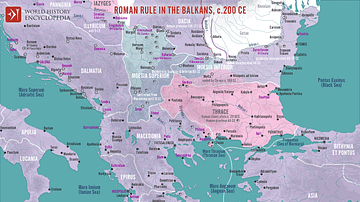
Roman Rule in the Balkans, c. 200 CE
Cite This Work
APA Style
Netchev, S. (2026, March 22). Map of Europe after the Congress of Berlin, 1878: From Italian and German Unification to Balkan Crisis. World History Encyclopedia. https://www.worldhistory.org/image/20139/map-of-europe-after-the-congress-of-berlin-1878/
Chicago Style
Netchev, Simeon. "Map of Europe after the Congress of Berlin, 1878: From Italian and German Unification to Balkan Crisis." World History Encyclopedia, March 22, 2026. https://www.worldhistory.org/image/20139/map-of-europe-after-the-congress-of-berlin-1878/.
MLA Style
Netchev, Simeon. "Map of Europe after the Congress of Berlin, 1878: From Italian and German Unification to Balkan Crisis." World History Encyclopedia, 22 Mar 2026, https://www.worldhistory.org/image/20139/map-of-europe-after-the-congress-of-berlin-1878/.
