


The missionary journeys of Paul the Apostle, also known as Saul of Tarsus, took place during the mid-1st century CE, within the interconnected world of the Roman Empire under emperors such as Claudius (reign 41–54 CE) and Nero (reign 54–68 CE). A central figure of the Apostolic Age, Paul played a decisive role in transforming Christianity from a small Jewish sect into a transregional movement. His travels across the eastern Mediterranean illustrate how Roman roads, maritime routes, and urban networks facilitated the rapid spread of religious ideas in antiquity.
Paul’s journeys, recorded in the Acts of the Apostles and echoed in his Epistles, demonstrate how early Christian teachings circulated through major cities such as Antioch, Ephesus, Corinth, and Rome. These texts, supported in part by Roman administrative records and archaeological evidence, reveal the empire as a space of intense cultural exchange. Despite facing opposition, imprisonment, and eventual execution, Paul’s missions helped establish durable Christian communities and bridged Jewish, Greek, and Roman traditions. His legacy shaped the theology, organization, and geographic reach of early Christianity, embedding it within the social and cultural structures of the Roman world.
Special thanks to Patrick Scott Smith for his research and input.
About the Author
Related Images
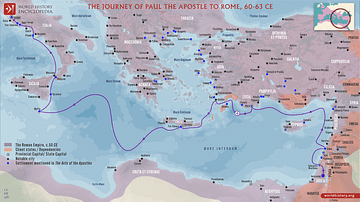
Paul the Apostle's Journey to Rome (c. 60-63 CE)

Paul the Apostle's First Missionary Journey (c. 46-48 CE)

Paul the Apostle's Second Missionary Journey (c. 49-52 CE)
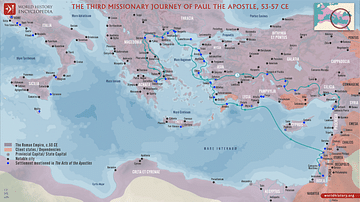
Paul the Apostle's Third Missionary Journey (c. 53-57 CE)

Map of Odysseus’ 10-year Journey Home

Map of the Early Christian Pilgrimage (4th-5th Century)
External Links
Cite This Work
APA Style
Netchev, S. (2025, December 25). Map of the Journeys of Paul the Apostle, c. 46-63 CE. World History Encyclopedia. https://www.worldhistory.org/image/19223/map-of-the-journeys-of-paul-the-apostle-c-46-63-ce/
Chicago Style
Netchev, Simeon. "Map of the Journeys of Paul the Apostle, c. 46-63 CE." World History Encyclopedia, December 25, 2025. https://www.worldhistory.org/image/19223/map-of-the-journeys-of-paul-the-apostle-c-46-63-ce/.
MLA Style
Netchev, Simeon. "Map of the Journeys of Paul the Apostle, c. 46-63 CE." World History Encyclopedia, 25 Dec 2025, https://www.worldhistory.org/image/19223/map-of-the-journeys-of-paul-the-apostle-c-46-63-ce/.
