


The Sasanian Empire (224–651 CE), known in Middle Persian sources as Ērānshahr (“Realm of the Iranians”), emerged as the final pre-Islamic Persian imperial state and a major power of Late Antiquity. Founded by Ardashir I (reign 224–242 CE) after the defeat of the Parthian Arsacid dynasty, the new regime sought to restore centralized authority across the Iranian plateau and Mesopotamia. Sasanian rulers cultivated ideological links with the earlier Achaemenid Empire (c. 550–330 BCE) while developing new administrative, military, and religious institutions centered on Zoroastrian royal legitimacy. From its capital at Ctesiphon, the empire governed a diverse territory stretching from the Persian Gulf and Mesopotamia to the Caucasus and Central Asia.
Throughout the 3rd–7th centuries CE, the Sasanians were the principal eastern rivals of the Roman Empire and later the Byzantine Empire, engaging in recurrent frontier wars that shaped the political landscape of the Near East. Early in the dynasty, Shapur I (reign 240–270 CE) famously captured the Roman emperor Valerian (reign 253–260 CE) after the Battle of Edessa (260 CE), a rare defeat for Rome. The empire reached its greatest territorial extent under Khosrow II (reign 590–628 CE), whose armies temporarily occupied Egypt, the Levant, and parts of Anatolia during the Byzantine–Sasanian War (602–628). Although these gains proved short-lived, the Sasanian state remained one of the dominant powers of Late Antiquity until the Arab conquests (633–651 CE) transformed the political and religious landscape of the region.
About the Author
Related Images

Map of the Migration Period in Europe in the 4th-5th Century

Territorial Expansion of the Sasanian Empire

Map of the Achaemenid Persian Empire c. 500 BCE

White Hun (Huna) Empire
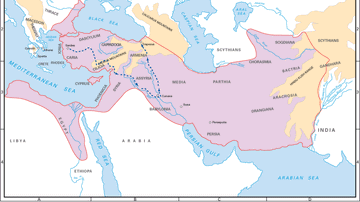
Map of Persia and the March of the Ten Thousand

Map of Romani Migration in the Middle Ages
Cite This Work
APA Style
Netchev, S. (2023, January 10). Map of the Sassanid Empire c. 620 CE: Persia’s Last Great Imperial Power. World History Encyclopedia. https://www.worldhistory.org/image/16853/map-of-the-sassanid-empire-c-620-ce/
Chicago Style
Netchev, Simeon. "Map of the Sassanid Empire c. 620 CE: Persia’s Last Great Imperial Power." World History Encyclopedia, January 10, 2023. https://www.worldhistory.org/image/16853/map-of-the-sassanid-empire-c-620-ce/.
MLA Style
Netchev, Simeon. "Map of the Sassanid Empire c. 620 CE: Persia’s Last Great Imperial Power." World History Encyclopedia, 10 Jan 2023, https://www.worldhistory.org/image/16853/map-of-the-sassanid-empire-c-620-ce/.
