
Celebrate Our Anniversary with Trivia!
Join us on August 23 for a free virtual trivia party featuring questions about ancient civilizations, U.S. history, unusual historical facts, pop culture, and more.


The 1910 Alexander III Equestrian Egg by Peter Carl Fabergé (1846-1920). The egg was given by Tsar Nicholas II (r. 1894-1917) to his mother the Dowager Empress Marie Feodorovna. It commemorates the unveiling of a statue of Tsar Alexander III (r. 1881-1894) in St. Petersburg in 1910. The egg is made of rock crystal with platinum mounts and decorated with rose diamonds. The gold equestrian figure is Tsar Alexander III, and it stands on a lapis-lazuli pedestal. It measures 13.5 cm (5.3 in) in height.
Armoury Museum, Kremlin, Moscow.
Related Images
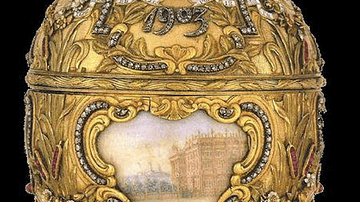
Peter the Great Egg by Fabergé
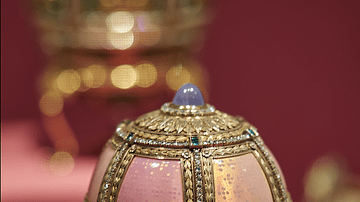
Danish Palaces Egg by Fabergé
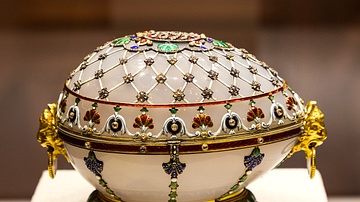
Renaissance Egg by Fabergé
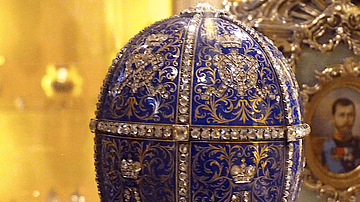
Twelve Monograms Egg by Fabergé

Lilies of the Valley Egg by Fabergé

Imperial Coronation Coach Egg by Fabergé
Cite This Work
APA Style
Shakko. (2021, May 03). Alexander III Equestrian Egg by Fabergé. World History Encyclopedia. https://www.worldhistory.org/image/13943/alexander-iii-equestrian-egg-by-faberge/
Chicago Style
Shakko. "Alexander III Equestrian Egg by Fabergé." World History Encyclopedia, May 03, 2021. https://www.worldhistory.org/image/13943/alexander-iii-equestrian-egg-by-faberge/.
MLA Style
Shakko. "Alexander III Equestrian Egg by Fabergé." World History Encyclopedia, 03 May 2021, https://www.worldhistory.org/image/13943/alexander-iii-equestrian-egg-by-faberge/.

