
History is a public good. Help us keep it that way.


A photorealistic representation of what the Roman emperor Marcus Aurelius (r. 161-180 CE) may have looked like. Based on contemporary and near contemporary descriptions, as well as archaeological evidence. Pictured alongside the reconstruction are the busts and statuary used as references. These include busts from the Glyptothek (top left); Musée des Antiques de Toulouse (top right); Musée Saint-Raymond (bottom left); and the Metropolitan Museum of Art (bottom right).
Related Images

Cleopatra VII (Artistic Facial Reconstruction)

Artistic Facial Reconstruction of Mark Antony
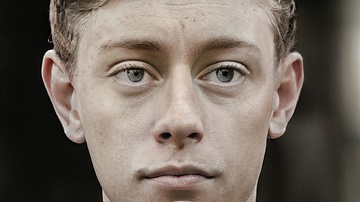
Arcadius (Artistic Facial Reconstruction)

Constantius Chlorus (Artistic Facial Reconstruction)

Alexander the Great (Artistic Facial Reconstruction)

Darius III (Artistic Facial Reconstruction)
Cite This Work
APA Style
Voshart, D. (2020, October 23). Marcus Aurelius (Artistic Facial Reconstruction). World History Encyclopedia. https://www.worldhistory.org/image/12998/marcus-aurelius-artistic-facial-reconstruction/
Chicago Style
Voshart, Daniel. "Marcus Aurelius (Artistic Facial Reconstruction)." World History Encyclopedia, October 23, 2020. https://www.worldhistory.org/image/12998/marcus-aurelius-artistic-facial-reconstruction/.
MLA Style
Voshart, Daniel. "Marcus Aurelius (Artistic Facial Reconstruction)." World History Encyclopedia, 23 Oct 2020, https://www.worldhistory.org/image/12998/marcus-aurelius-artistic-facial-reconstruction/.
