
Search
Did you mean: Nile?
Remove Ads
Advertisement
Search Results

Article
Death, Burial & the Afterlife in the Ancient Celtic Religion
The ancient Celts who occupied large parts of Europe from 700 BCE to 400 CE displayed a clear belief in an afterlife as evidenced in their treatment of the dead. In the absence of extensive...
Article
Etruscan Trade
The Etruscan civilization flourished in central Italy between the 8th and 3rd century BCE, and their prosperity was largely based on their exploitation of local mineral resources, both through manufactured goods and trade. The...

Image
A Nereid & a Sea Centaur
A fragment of a gilded silver wine jug from southern Spain (10.5 cm in height; ca. 1st cent. BCE; APM inv. no. 15.375). The image is “rolled” out to compensate for the curvature of the vase neck. The scene illustrates a...
Image
Greek Volute Krater
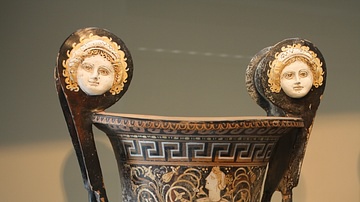
This vessel was used to mix wine and water and dates from the second half of the fourth century BCE. Provenance: Apula. Depicted are two female figures with gifts approaching a deceased person seated on a funeral monument...
Image
Assyrian Storage Jar
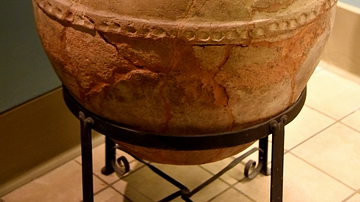
This jar was found in one of the wine-cellars in the arsenal at Nimrud (ancient Kalhu). It is marked in cuneiform with its capacity; 1 homer, 3 seah, 7 qa. In fact, it holds about 300 liters. Assyrian, late 7th century BCE...

Image
Queen Puabi's Seal
This seal was found by Puabi's right arm inside her grave. The seal depicts a banquet/feast scene, in two horizontal registers; one of the typical themes of the Early Dynastic III seals. Each register depicts a man and a woman...

Image
Chinese Bronze Ritual Vessel, Hu
A "hu" is a type of wine vessel which displays a pear-shaped cross-section. This bronze carries a fine example of the monster face, known as taotie, shown in the main central panel, with its eyes on each side of the...

Image
Champagne Capsules of Veuve Clicquot
A selection of Veuve Clicquot champagne capsules, used with a wire cage to keep the cork of the wine in place. The face is Madame Barbe-Nicole Clicquot-Ponsardin (1777-1866), who designed the VCP and anchor logo...

Image
Red-Figure Bell-Krater Showing Revellers
This is a bowl for mixing wine and water. Greek, made in Athens around 450-440 BCE. Said to be Aegina, Greece. (The British Museum, London).

Article
Holidays in the Elizabethan Era
During the Elizabethan Era (1558-1603 CE), people of all classes greatly looked forward to the many holidays and festivals on offer throughout the year. The vast majority of public holidays were also religious commemorations...
