
Search
Did you mean: Rhea?
Remove Ads
Advertisement
Search Results

Article
Sacred Cakes in Ancient Greece
Sacred cakes in ancient Greece were baked loaves, biscuits, pastries, and sponges sweetened with honey (meli) and prepared as unburnt offerings to the gods and goddesses and other divine beings. Unburnt offerings were...

Article
The Nebra Sky Disk - Ancient Map of the Stars
The Nebra Sky Disk is one of the most fascinating, and some would say controversial, archaeological finds of recent years. Dated to 1600 BCE, this bronze disk has a diameter of 32cm (about the size of a...

Article
Siege of Sevastopol in 1941-2
The siege of Sevastopol (Oct 41 to Jul 42) was an attack by Axis forces on the base of the USSR's Black Sea Fleet during Operation Barbarossa of the Second World War (1939-45). Sevastopol (aka Sebastopol) had one of...
Image
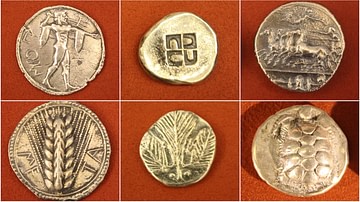
Greek Silver Coins
Top row (L to R): Poseidonia (520 BCE) - Silver stater, Poseidon with trident. Corinth (525-500 BCE) - Silver stater, incuse square of swastika design. Syracuse (c. 400 BCE) - Silver decadrachm, quadriga with Nike crowning...

Image
Isis from Dion, Greece
Votive relief with a depiction of Isis, from the facade of the main temple of the Sanctuary of Isis in Dion (Greece). Second half of 3rd–early 2nd century BCE. Isis was an Egyptian goddess who became popular around the Mediterranean...

Image
The Columbian Exchange - Global Connections and Consequences after 1492
The Columbian Exchange (from 1492 CE) refers to the large-scale transfer of plants, animals, diseases, peoples, and technologies between the Americas and Afro-Eurasia following the transatlantic...
Image
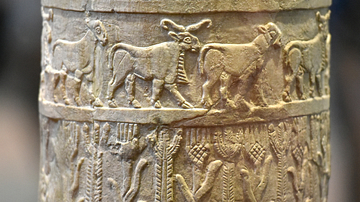
Warka Vase [Bottom Register]
The votive or sacred Warka Vase is decorated with three horizontal registers and shows signs of repair in antiquity. The bottom register of the Warka Vase is composed of two horizontal parts. The lower portion depicts...

Collection
Religious Beliefs and Practices of the Ancient Egyptians
Religion was interwoven throughout the life of ancient Egypt, and was connected to Egyptian mythology, science, and medicine to name a few. From the mightiest Pharaonic king to the farmers harvesting...

Image
Map of the Fertile Crescent and the Origins of Agriculture - Early Farming and Domestication in the Ancient Near East
The Fertile Crescent, a term coined in 1916 by Egyptologist James Henry Breasted, describes an arc of Southwest Asia stretching from the eastern Mediterranean...

Image
Neo-Hittite King Suppiluliuma
Neo-Hittite statue of King Suppiluliuma unearthed in 2012 at Kunulua, the capital of the Neo-Hittite Kingdom of Patina (1000-738 BCE) in southeastern Turkey. The remains of the figure stand approximately 1.5 meters...
