
Search
Did you mean: Epona?
Remove Ads
Advertisement
Search Results

Definition
Clovis I
Clovis I (or Chlodovech, 466-511/513 CE), king of the Franks, is considered the founding father of the Merovingian Dynasty, which would continue for over 200 years. Clovis became king at the age of 15, and by the time of his death 30...

Definition
Mithra
Mithra is the Persian god of the rising sun, contracts, covenants, and friendship. He also oversaw the orderly change of the seasons, maintained cosmic order, and was responsible for bestowing divine grace on kings, legitimizing their...

Definition
Caracalla
Caracalla was Roman emperor from 211 to 217 CE. Born Lucius Septimius Bassianus, son of Septimius Severus and Julia Domna, he became co-ruler with his father in 198 CE and sole ruler after the death of his father in 211 CE and of his...

Definition
Hallstatt Culture
The Hallstatt culture is named after the site of that name in Austria and it flourished in central Europe from the 8th to 6th century BCE. The full period of its presence extends from c. 1200 to c. 450 BCE - from the Late Bronze...

Definition
Roman Warfare
Roman warfare was remarkably successful over many centuries and across many territories. This was due to several important factors. Italy was a peninsula not easily attacked, there was a huge pool of fighting men to draw upon, a...

Definition
Krishna
Krishna (Krsna or Hari Krishna) is a major god of the Hindu pantheon and considered the eighth incarnation of Vishnu. He is perhaps the most popular of all the heroes of Hindu mythology. Krishna's adventures appear in the Mahabharata...

Definition
Telesilla of Argos
Telesilla of Argos was a lyric poet of the 5th century BCE, listed by Antipater of Thesalonike (c. 15 BCE) as one of the great Nine Female Lyric Poets of Greece (along with Praxilla, Moiro, Anyte, Sappho, Erinna, Corinna, Nossis...

Definition
Attila the Hun
Attila the Hun (r. 434-453 CE) was the leader of the ancient nomadic people known as the Huns and ruler of the Hunnic Empire, which he established. His name means "Little Father" and, according to some historians, may not have...

Definition
Nok Culture
The Nok culture, named after the settlement of the same name, flourished in southern West Africa (modern Nigeria) during the Iron Age from the 5th century BCE to the 2nd century CE. Famous for the distinctive terracotta sculptures...
Definition
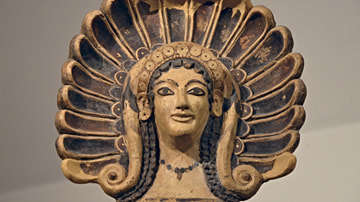
Veii
Veii (modern name: Isola Farnese, in Etruscan: Vei), was an important Etruscan town located near the west coast of central Italy. Lying just 16 km north of Rome, it was the most southerly of the major Etrurian settlements. The prosperity...
