
Search
Remove Ads
Advertisement
Search Results

Definition
Korean Pottery
The pottery of ancient Korea stretches back to prehistory when simple brown wares were made and decorated with geometrical incisions. Potters would benefit from the ideas and techniques of their Chinese counterparts and go on to...

Definition
Byzantine Architecture
The architecture of the Byzantine Empire (4th - 15th century CE) continued its early Roman traditions but architects also added new structures to their already formidable repertoire, notably improved fortification walls and...

Definition
Uluru
Uluru (also known as Ayers Rock and pronounced: ool-or-roo) is a large natural sandstone rock formation located in the Northern Territory of Australia. It stands at a massive 348 meters tall and measures a lengthy 9.4 km in width. The...

Definition
Archelaus (Philosopher)
Archelaus of Athens (l. c. 5th century BCE) was a Pre-Socratic philosopher in ancient Greece who claimed the first cause of existence was the opposition of cold and heat which caused the separation of the universal essence...

Definition
Battle of the Granicus
The Battle of the Granicus in May 334 BCE was Alexander the Great's (356-323 BCE) first major victory against the forces of the Achaemenid Empire. Alexander had crossed the Hellespont with his combined Macedonian and Greek...

Definition
Athens
Athens, Greece, with its famous Acropolis, has come to symbolize the whole of the country in the popular imagination, and not without cause. It not only has its iconic ruins and the famous port of Piraeus but, thanks to ancient writers...

Definition
Ionia
Ionia was a territory in western Anatolia (modern-day Turkey) populated by the Ionians (Greeks who spoke the Ionian dialect) in c. 1150 BCE. It is best known as the birthplace of Greek philosophy (at Miletus) and the site of the Ionian...

Definition
Sargon of Akkad - From Gardener to King of the Four Corners of the World
Sargon of Akkad (reign 2334-2279 BCE) was the king of the Akkadian Empire of Mesopotamia, the first multinational empire in history, who united the disparate kingdoms of the region under...

Definition
Anaxagoras
Anaxagoras (l. c. 500-c. 428 BCE) was a Pre-Socratic Greek philosopher who claimed the First Cause of existence was Mind (nous) and all things were constituted of indestructible “seeds” (or “stuff”), originally a single mass, separated...
Definition
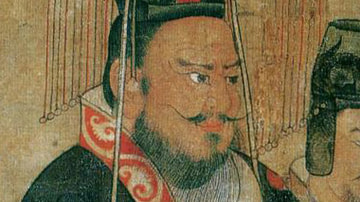
Chinese Emperor
The emperors of ancient China had tremendous power and responsibility. Called the 'Son of Heaven', he (and once she) was given a divine right to rule over all people but was expected to promote their best interest and not his...
