
Search
Remove Ads
Advertisement
Search Results
Image
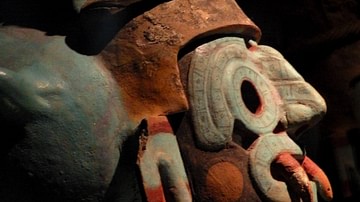
Tlaloc
A 15th century CE vase representing the Mesoamerican god of rain, storms and agriculture Tlaloc. From the Templo Mayor in Tenochtitlan. (National Museum of Anthropology, Mexico City).

Image
Andromeda Being Tied for Sacrifice
Andromeda being tied for sacrifice. Apulian red-figure vase, attributed to the Sisyphus Group, c. 430-420 BCE.
National Archaeological Museum of Taranto.

Image
Fury, Phaedra & Hippolytos
A red-figure vase depicting one of the Furies hovering over Hippolytos, an attendant, and Phaedra. 330-310 BCE. (Metropolitan Museum of Art, New York)
Image
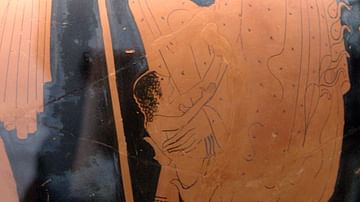
Gaia & Erichthonius
A red-figure vase depicting the earth goddess Gaia giving the baby Erichthonius to Athena. 470-460 BCE. (Staatliche Antikensammlungen, Munich)

Image
Odysseus and the Sirens
An Attic red-figure stamnos, depicting the myth of Odysseus tied to his ship's mast in order to resist the enchanting song of the Sirens. The episode occurs during the hero's long voyage home to Ithaka following the end...
Image
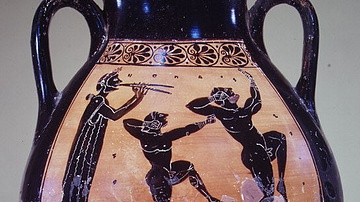
Terracotta Pelike Showing Flute Player and Boxers
This pelike, or wine jar, is a Greek piece, specifically Attic, displaying beautiful black-figure work customary of Athenian pottery. The scene shows a flute player and two boxers. It was dated to the...
Image
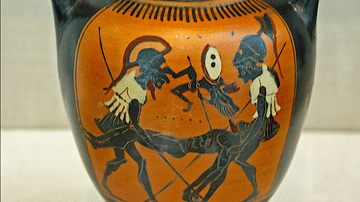
Thanatos & Hypnos with Sarpedon
A detail of a black-figure pottery vase showing Thanatos (Death) and Hypnos (Sleep) carrying the dead body of the hero Sarpedon. Made around 500 BCE in Attica, Greece. (Metropolitan Museum of Art, New York)

Image
Castor and Pollux
A red-figure vase possibly depicting Castor and Pollux (the Dioscuri), the hero twins of Greek mythology. 420-400 BCE, Lucanian. (Museo Provinciale Archeologico 'S. Castromediano,' Lecce, Italy)

Image
Menelaos & Helen
A scene from a red-figure vase showing Menelaos re-capturing Helen during the Trojan War. 480 BCE. (Staatliche Antikensammlungen, Munich)
Image
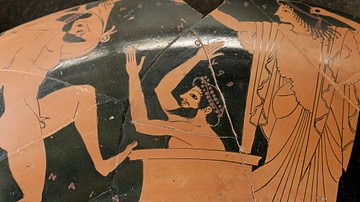
King Eurystheus Hiding from Hercules
A detail of a red-figure vase showing the king of Argos, Eurystheus, hiding from Hercules who, after one of his labours, carries the Erymanthian boar. (Louvre Museum, Paris)
