
Search
Remove Ads
Advertisement
Search Results
Image
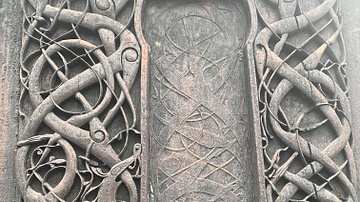
Woodcarvings - Urnes Stave Church
Woodcarving decoration on the north side of the Urnes Stave Church in Ornes, Norway. The church dates from c. 1130 CE and was included on the UNESCO World Heritage list in 1979 CE. The carvings, based on traditional...
Image
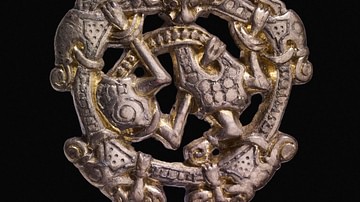
Borre-style Pendant with a Gripping Beast
Pendant with a Borre-style design of a gripping beast inside a frame further decorated with four protruding animal heads. Small areas of gilding and niello are in evidence on the surface of the pendant. Found...

Image
Functional Wood Selection - Viking Ship Construction 7
In Viking shipbuilding, instead of relying on a single ideal tree, a functional selection system was applied. Hardwoods such as oak were preferred for the keel, while lighter softwoods such as pine...

Image
Sorting the Logs - Viking Ship Construction 15
When the logs for a Viking ship reached the shipyard or timber yard, they were sorted by quality and intended use. At this early stage, builders had already decided which trunks would serve for the keel...

Image
Managing Knots - Viking Ship Construction 8
Viking shipbuilders strengthened knot-related weak points in the oak planks with patches fastened from the outside. This management of defects was aimed at minimising the structural risks created by knots...

Image
Splitting at the Timber Yard - Viking Ship Construction 16
In the Viking timber yard, large logs were split from the root end. Small wedges first opened a line, then larger wedges and mallet blows drove the split deeper, and the wood followed its natural...

Image
Wool Caulking - Viking Ship Construction 24
Before the overlap surfaces were closed on a Viking ship, a tarred three-ply wool cord was placed between them. Once compressed, this fibrous filler both closed the gap and made the entry of water more difficult...

Image
Map of the World Known to Europeans c. 1000 CE - Trade, Travel & the Limits of Geographic Knowledge
Around 1000 CE, European knowledge of the wider world was uneven and depended heavily on geography, trade, religion, and contact with neighboring societies. In...

Image
Broad-Bladed Axes - Viking Ship Construction 1
The broad-bladed axe was the Viking shipbuilder’s most important tool, and had been designed to turn oak logs into thin boards. Using these axes instead of a saw preserved the grain structure of the wood...

Image
Radial Cleaving - Viking Ship Construction 9
For the clinker planks for a Viking ship, the tree was split radially from the centre outward. Unlike a saw, this process did not cut the fibres and preserved the natural strength of the wood. This first...
