
Search
Did you mean: Galen?
Remove Ads
Advertisement
Search Results

Definition
Constantinople
Built in the seventh century BCE, the ancient city of Byzantium proved to be a valuable city for both the Greeks and Romans. Because it lay on the European side of the Strait of Bosporus, the Emperor Constantine understood its...

Definition
Basil the Great
Saint Basil (c. 330 - c. 379 CE), also known as Basil the Great and Basil of Caesarea, was a bishop of Caesarea in central Asia Minor who staunchly defended the church against the 4th-century CE heresy of Arianism. Basil's writings...

Article
Fall of the Western Roman Empire
To many historians, the fall of the Western Roman Empire in the 5th century CE has always been viewed as the end of the ancient world and the onset of the Middle Ages, often improperly called the Dark Ages, despite...

Article
Sack of Rome 410 CE
In August of 410 CE Alaric the Gothic king accomplished something that had not been done in over eight centuries: he and his army entered the gates of imperial Rome and sacked the city. Although the city and, for a time, the...
Image
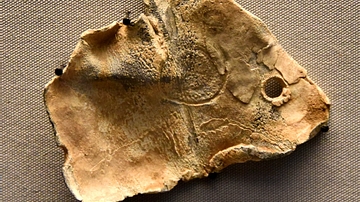
Lead Sheet with Coin Impression
This sheet is decorated with an impression of a coin of the Emperor Valens (Flavius Julius Valens Augustus), 364-378 CE. It may have been intended as a curse against the Emperor. From Fulstow, UK. Donated by Tom Redmayne...

Definition
Roman Emperor
Roman emperors ruled the Roman Empire starting with Augustus in 27 BCE and continuing in the West until the late 5th century CE and in the Eastern Roman Empire up to the mid-15th century CE. The emperors took titles such as Caesar...

Article
Continuity and Change after the Fall of the Roman Empire
The cataclysmic end of the Roman Empire in the West has tended to mask the underlying features of continuity. The map of Europe in the year 500 would have been unrecognizable to anyone living a...

Article
Visual Chronology of Roman Emperors: Augustus to Constantine
The Julio-Claudian Dynasty Augustus 16 Jan 27 BCE - 19 Aug 14 CE Tiberius 18 Sep 14 CE - 16 Mar 37 CE Caligula 18 Mar 37 CE - 24 Jan 41 CE Claudius 25 Jan 41 CE - 13 Oct 54 CE Nero 13...

Definition
Roman Empire
The Roman Empire, at its height (c. 117), was the most extensive political and social structure in western civilization. Building upon the foundation laid by the Roman Republic, the empire became the largest and most powerful political...

Definition
Huns
The Huns were a nomadic tribe prominent in the 4th and 5th century whose origin is unknown but, most likely, they came from "somewhere between the eastern edge of the Altai Mountains and the Caspian Sea, roughly modern Kazakhstan" (Kelly...
