
Search
Did you mean: Ur?
Remove Ads
Advertisement
Search Results

Image
Stela of King Shamshi-Adad V
Stela of the Assyrian king Shamshi-Adad V (r. 824-811 BCE), from Nimrud (ancient Kalhu), modern-day northern Iraq, Neo-Assyrian Empire, 824-811 BCE. It depicts the king, before the symbols of his principal gods. He...

Image
Pottery Jar from Ninevite V Period
This pottery jar was handmade and painted. It is carinated and stemmed with four equidistant vertically perforated lugs on the carination. Ninevite 5 Period, 3000-2750 BCE. From Nineveh, Northern Mesopotamia, Iraq...
Image
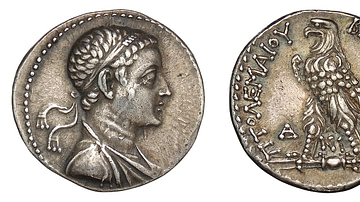
Ptolemy V Epiphanes Tetradrachm
Tetradrachm of Ptolemy V Epiphanes (r. 205-180 BCE). Portrait of Ptolemy on obverse, Ptolemaic eagle on reverse with the legend "Ptolemy Basileus" (meaning "King Ptolemy"). Minted in Phoenicia. Münzkabinett der Staatlichen...
Image
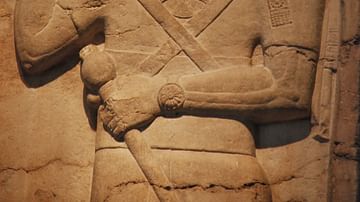
King Shamshi-Adad V
Assyrian stela of Shamshi-Adad V (823-811 BCE) from the temple of Nabu in Nimrud, c. 814 BCE, showing the kind worshipping symbols of the gods. The cross on the king's chest is a symbol of the sun god. Through his dress the...

Image
Coin of Philip V of Macedon
Philip V of Macedon, 221–179 BCE, coin in British Museum.

Image
Marriage of Henry V of England and Catherine of Valois
A late-15th century CE illustration of the marriage of Henry V of England (r. 1413-1422 CE) and Catherine of Valois (l. 1401 - c. 1437 CE), daughter of Charles VI of France (r. 1380-1422 CE). The...
Image
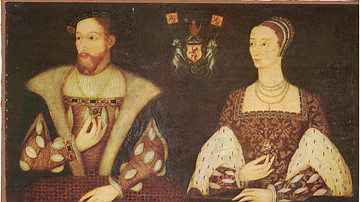
James V of Scotland & Mary of Guise
A painting showing James V of Scotland (r. 1513-1542) and his second wife Mary of Guise (1515-1560).
Falkland Palace, Fife, Scotland.
Image
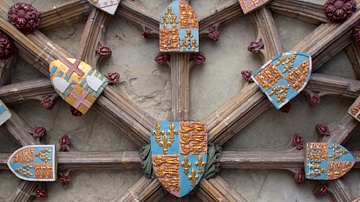
Henry V Coat of Arms, Canterbury Cathedral
A view of the entrance ceiling of the South Porch at Canterbury Cathedral showing the coats of arms of Henry V of England (r. 1413-1422 CE) in the centre along with those of various other nobles.

Image
Papyrus Anastasi V
Prayer to Thoth for skill in writing. The prayer is written in hieratic script, found at Thebes sometime prior to c. 1830 CE, and purchased by the British Museum in 1839 CE from the collector Giovanni Anastasi.
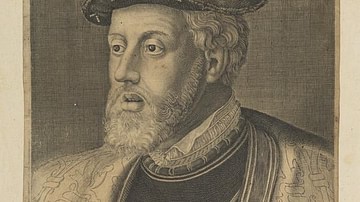
Image
Charles V, Holy Roman Emperor
Portrait of Charles V, Holy Roman Emperor (1500-1558), line engraving on paper by Barthel Berham.
Scottish National Portrait Gallery, Edinburgh.
