
Search
Remove Ads
Advertisement
Search Results

Article
Vikings: Jewelry, Weapons & Social Change at The VIKINGR Exhibition
In April 2019, The Museum of Cultural History in Oslo, Norway, opened its doors to the new exhibition VÍKINGR, containing rich treasures and unique archaeological finds from the Viking...

Article
The Differences Between Byzantine & Armenian Christianity
Although both the Byzantines and the Armenians were Christian, the types of Christianity they professed had important differences that led to a lack of recognition and tensions between the two...

Article
De-Ka-Nah-Wi-Da and Hiawatha
De-Ka-Nah-Wi-Da and Hiawatha is the written account of the oral history of the origins of the Haudenosaunee (Iroquois) Confederacy, detailing how the great peacemaker Dekanawida (De-Ka-Nah-Wi-Da) met Chief Hiawatha and...
Article
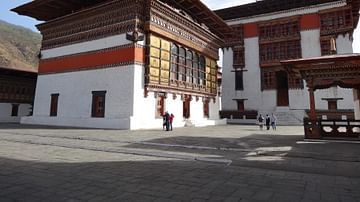
Bhutan: Land of the Thunder Dragon
It is a breathtaking flight with dramatic sweeps over fertile valleys and blue pine forests. You fly past Mt. Everest, Mt. Kanchenjunga and Mt. Gangkhar Puensum, which is the highest, unclimbed mountain in the world...

Article
Foreign Influences & Imported Luxuries in Thrace
Defining Thracian art is a difficult task due to the fact that what we call today Thrace was never a single unified state but, rather, a collection of many independent communities (or tribes) who formed...

Article
Diodorus Siculus: The Battle of Chaeronia
In the following excerpt from his Library of History, Book XVI, chapter 14, the historian Diodorus Siculus (1st century BCE) chronicles the famous Battle of Chaeronia of 338 BCE, in which Phillip II of Macedon...

Image Gallery
A Gallery of Italian Colonialism
The history of Italian colonialism unfolded in a relatively short period, between the late 19th century and the Second World War (1939-45). After the unification of Italy, the young kingdom sought to establish itself...

Image
Map of Europe on the Eve of World War I, June 1914 - Alliances, Empires, Borders, and Military Power
Between German unification (1871) and the outbreak of the First World War (1914), European international relations were increasingly shaped by alliance diplomacy...
Image
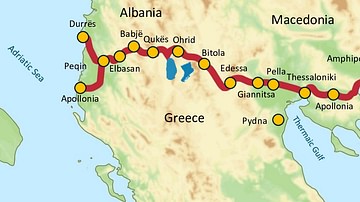
Via Egnatia, 146 BCE to c. 1200 CE
Via Egnatia was a major Roman road in the Balkans, stretching 1,120 kilometers (696 miles) from the Adriatic Sea in the west to the Black Sea and the Sea of Marmara in the east. The western terminus is slightly...

Image
Imperial Dynasties of China Visual Timeline - Chinese History from Xia and Shang to Ming and Qing
The dynastic history of China traditionally extends from the semi-legendary Xia dynasty (traditionally c. 2070–1600 BCE) through the Shang (c. 1600–1046 BCE) and...
