
Search
Remove Ads
Advertisement
Search Results
Definition
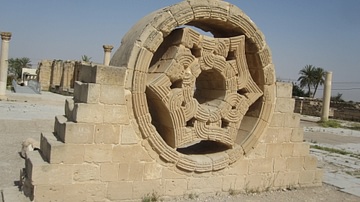
Hisham's Palace
Hisham's Palace at Khirbat al-Mafjar (the ruins of Mafjar) is an Umayyad structure that is listed among the last of the surviving antiquities of Romans and Byzantines. It was built by Walid Ibn Yazid in 734 CE near Jericho in the Jordan Valley...

Video
Quseir Amra: Paintings of the Umayyad Desert Castle
Discover the mysterious, 1,300-year-old treasures of the Jordanian desert. We explore the trending visuals of Quseir Amra and the secrets hidden within its ancient limestone walls. See "forbidden" art that was viral a millennium ago—images...

Definition
Abbasid Dynasty
The Abbasids were an Arabic dynasty that initially ruled over most of the Islamic empire (save some western parts) after assuming the caliphate in 750 CE, later on, their empire fragmented, however, they retained spiritual supremacy as caliphs...

Definition
Taifa
Taifas ("factions" or "camps") were small independent Muslim kingdoms and principalities that emerged after the fall of hegemonic Muslim caliphates in al-Andalus – the Muslim-controlled part of the Iberian peninsula – during the High Middle...

Definition
Islamic Caliphates
Caliphate (“Khilafat” in Arabic) was a semi-religious political system of governance in Islam, in which the territories of the Islamic empire in the Middle East and North Africa and the people within were ruled by a supreme leader called...

Video
Abbasid Revolution - How the Umayyad Caliphate Fell DOCUMENTARY
Kings and Generals historical animated documentary series on the history of medieval history, as well as the history of Islam continues with a video on the Abbasid Revolution, as we see which events led to the fall of the Umayyad Caliphate.

Definition
Islam
Islam is an Abrahamic-monotheistic religion based upon the teachings of Prophet Muhammad ibn Abdullah (l. 570-632 CE, after whose name Muslims traditionally add “peace be upon him” or, in writing, PBUH). Alongside Christianity and Judaism...

Definition
Ali ibn Abi Talib
Ali ibn Abi Talib, or simply Ali, (l. 601-661 CE) was among the first Muslims, a cousin and son-in-law of the Islamic Prophet Muhammad (l. 570-632 CE), and later reigned as the fourth Caliph of Islam from 656 CE to 661 CE, when he was murdered...

Definition
Rashidun Caliphate
The first four caliphs of the Islamic empire – Abu Bakr, Umar, Uthman, and Ali are referred to as Rashidun (rightly guided) Caliphs (632-661 CE) by mainstream Sunni Muslims. Their tenure started with the death of Prophet Muhammad in 632 CE...

Definition
First Fitna
The First Fitna (656-661 CE) was the first civil war of the Islamic Empire fought between the fourth Rashidun Caliph, Ali ibn Abi Talib (656-661 CE), and the governor of Syria, Muawiya (later Muawiya I; r. 661-680 CE). Deep fissures divided...
