
Search
Remove Ads
Advertisement
Search Results

Definition
Kos
Kos (Cos) is a Greek island in the south-east Aegean, part of the Dodecanese (ancient Sporades) group which prospered in antiquity due to its location on trade routes between Egypt, Syria, Cyprus, and Anatolia. Settled from the Bronze Age...

Definition
Roman Literature
The Roman Empire and its predecessor the Roman Republic produced an abundance of celebrated literature; poetry, comedies, dramas, histories, and philosophical tracts; the Romans avoided tragedies. Much of it survives to this day...

Definition
Penelope - The Loyal Wife of Odysseus
In Greek mythology, Penelope is the wife of Odysseus, the king of Ithaca, and the mother of Telemachus. She is best known for her unwavering loyalty and fidelity to her husband during his 20-year-long absence and...

Definition
Brundisium
Brundisium (modern Brindisi), located on the Adriatic coast of southern Italy, was a Messapian and then Roman town of great strategic importance throughout antiquity. Although architectural remains are sparse, the city has several...

Definition
Hippolyta
Hippolyta, or Hippolyte, was a queen of the Amazons in Greek mythology. A daughter of Ares, the Greek god of war, and Otrera, queen of the Amazons, she is a significant figure in the legends of Hercules and Theseus. In the present...

Definition
Sounion
Sounion (or Sunium) was an important ancient Greek religious sanctuary sacred to the gods Poseidon and Athena. Spectacularly located on a promontory in southern Attica, the site is dominated by the temple of Poseidon perched on the cliff...
Definition
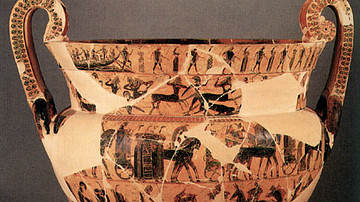
François Vase
The François Vase is a large Attic volute-krater dating to c. 570-565 BCE, and it is perhaps the example par excellence of the black-figure pottery style. An astonishing range of scenes and characters from Greek mythology cover...

Definition
Ancient Greek Medicine
In ancient Greek medicine illness was initially regarded as a divine punishment and healing as, quite literally, a gift from the gods. However, by the 5th century BCE, there were attempts to identify the material causes for...

Definition
Hades
Hades was both the name of the ancient Greek god of the underworld (Roman name: Pluto) and the name of the shadowy place below the earth which was considered the final destination for the souls of the dead. Perhaps the most feared of...

Definition
Scylla and Charybdis - The Monsters Who Guarded Sicily
Scylla and Charybdis were monsters from Greek mythology thought to inhabit the Straits of Messina, the narrow sea between Sicily and the Italian mainland. Preying on passing mariners, Scylla was a...
