
Search
Remove Ads
Advertisement
Search Results

Article
Trade Goods of the East India Company
The English East India Company (EIC) was founded in 1600, and it came to control both trade and territories in India, as well as a trade monopoly with China. Goods the EIC traded included spices, cotton cloth...

Article
Trade in the Roman World
Regional, inter-regional and international trade was a common feature of the Roman world. A mix of state control and a free market approach ensured goods produced in one location could be exported far and wide. Cereals...

Article
Trade in the Phoenician World
The Phoenicians, based on a narrow coastal strip of the Levant, put their excellent seafaring skills to good use and created a network of colonies and trade centres across the ancient Mediterranean. Their major trade...

Article
Trade in Ancient Greece
Trade was a fundamental aspect of the ancient Greek world and following territorial expansion, an increase in population movements, and innovations in transport, goods could be bought, sold, and exchanged in one part of...

Article
Trade Unions in the British Industrial Revolution
Trade unions were formed in Britain during the Industrial Revolution (1760-1840) to protect workers from unnecessary risks using dangerous machines, unhealthy working conditions, and excessive hours...

Image
Map of Ancient & Medieval Sub-Saharan African States
A map indicating the major ancient and medieval states in sub-Saharan Africa. Areas and dates relate to a state at its peak. In addition, shaded areas are approximate indicators only. For the majority...

Article
Eyes on the East: Chronicles of the Indian Ocean Spice Trade
As the 15th century ended, Europeans were still mostly in the dark about the Eastern world. Early travelers like Marco Polo had given the West tidbits of information, but these accounts were...
Image
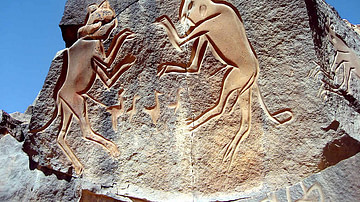
Saharan Rock Carving of Two Cats Fighting
This prehistoric Saharan rock carving from Wadi Mathendous in the Fezzan, Libya depicts two cats fighting. Similar petroglyphs can be found in rock escarpments throughout the Sahara, providing valuable clues...
Article
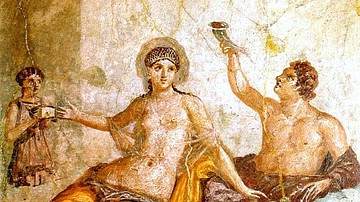
The Eastern Trade Network of Ancient Rome
The life of wealthy Romans was filled with exotic luxuries such as cinnamon, myrrh, pepper, or silk acquired through long-distance international trade. Goods from the Far East arrived in Rome through two corridors...

Article
Paul's Journeys and the Mediterranean Trade
Mediterranean trade increased exponentially at the turn of the first millennium. During Rome's zenith, goods of all sorts began to move in all directions. As a common traveler aboard merchant ships, Paul...
