
Search
Remove Ads
Advertisement
Search Results
Article
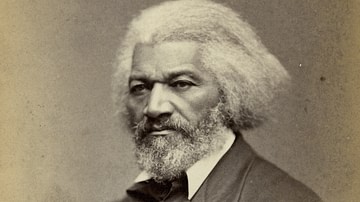
What to the Slave is the Fourth of July? - Frederick Douglass' Challenge to America
"What, to the Slave, is the Fourth of July?" is Frederick Douglass' masterwork of oration, delivered on 5 July 1852 at the Corinthian Hall in Rochester, New York. Also sometimes...

Article
12 Great Cities of Ancient Mesopotamia - The Rise and Fall of the Earliest Cities in the World
The great cities of Mesopotamia ("the land between two rivers") developed prior to the late 4th millennium BCE along two rivers – the Tigris and Euphrates – and were...

Article
Food & Agriculture in Ancient Greece
The prosperity of the majority of Greek city-states was based on agriculture and the ability to produce the necessary surplus which allowed some citizens to pursue other trades and pastimes and to create a quantity...

Definition
Copper in Antiquity
Copper was probably the first metal used by ancient cultures, and the oldest artefacts made with it date to the Neolithic period. The shiny red-brown metal was used for jewellery, tools, sculpture, bells, vessels, lamps, amulets...

Definition
Sumerians - Inventors of Civilization
The Sumerians were the people of southern Mesopotamia (modern-day southern Iraq) whose civilization flourished between circa 4000 and 1750 BCE. Their name comes from the region, which is frequently – and incorrectly...

Article
The Phoenicians - Master Mariners
Driven by their desire for trade and the acquisition of such commodities as silver from Spain, gold from Africa, and tin from the Scilly Isles, the Phoenicians sailed far and wide, even beyond the Mediterranean's...

Image
Map of the Dutch Commercial Empire, c. 1665 - A Global Network of Commerce, Exploration and Maritime Power
A map of the Dutch commercial empire which reached its height during the Dutch Golden Age (c. 1588-1672), when the Dutch Republic (1588-1795) emerged as one...

Image
Map of the Suez Canal at its Opening, c. 1869 - Engineering, Empire, and the Remaking of Global Trade
The opening of the Suez Canal on 17 November 1869 marked a major transformation in global maritime commerce, linking the Mediterranean and Red Seas through a...

Video
Making History - Mass production of olives for trade
Stone age people begin to produce a surplus of food so they can trade it to neighboring villages for food or products not available in their area
Image
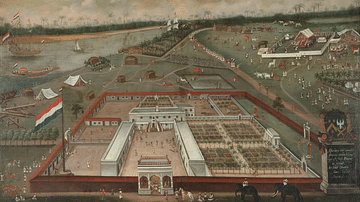
VOC Trade Lodge in Hooghly, Bengal
A 1665 painting by Hendrik van Schuylenbergh showing the Dutch East India Company (VOC) Trade Lodge in Hooghly, Bengal. (Rijksmuseum, Amsterdam)
