
Search
Remove Ads
Advertisement
Search Results

Definition
Wolof Empire
The Wolof (aka Jolof or Djolof) Empire was a state on the coast of West Africa, located between the Senegal and Gambia rivers, which thrived from the mid-14th to mid-16th century CE. The empire prospered on trade thanks to the two...

Definition
Ancient Greek Religion
In the ancient Greek world, religion was personal, direct, and present in all areas of life. With formal rituals which included animal sacrifices and libations, myths to explain the origins of mankind and give the gods a...

Definition
Xerxes I
Xerxes I (l. 519-465, r. 486-465 BCE), also known as Xerxes the Great, was the king of the Persian Achaemenid Empire. His official title was Shahanshah which, though usually translated as `emperor', actually means `king of kings'. He...

Definition
Pisistratus - Tyrant of Ancient Athens
Pisistratus (circa 600-527 BCE), or Peisistratus, was an ancient Greek tyrant who ruled the city-state of Athens. Initially a student of the lawgiver and political philosopher Solon, Pisistratus presented himself...
Definition
Punt
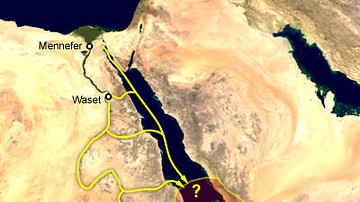
The Land of Punt was a region in Africa (most likely Somalia) referenced by inscriptions of ancient Egypt initially as a partner in trade and, later, as a semimythical country rich in resources and exotic goods. It is best known from the...

Definition
Ancient Britain
Ancient Britain was a landmass on the northwest of the continent of Europe first occupied by humans c. 800,000 years ago prior to it becoming an island c. 6000 BCE due to flooding which separated it from the mainland. Agriculture...

Definition
Naukratis
Naukratis (also spelled Naucratis, and known as Nokraji to the ancient Egyptians) was a city in Lower Egypt, located in the Canopic (or western) branch of the Nile delta, which became a powerful trading port between the Egyptians and...
Image
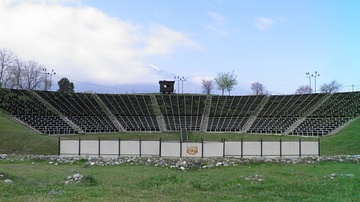
Dion Hellenistic Theatre, Greece
The Hellenistic Theatre at Dion in Macedon with Mount Olympus in the background. The theatre was built into a natural hill during the 3rd century BCE. It underwent several phases of modification during the reign of...

Image
The Bath, Nemea, Greece
The Bath (last third of the 4th century BCE) was used for washing and bathing by athletes (and possibly also spectators) during the games. A large central pool - waist deep - is flanked by two tub rooms with wash basins...
Image
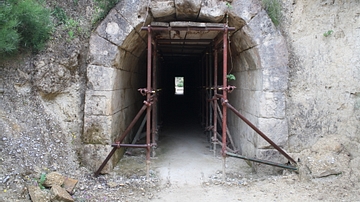
Stadium Entrance, Nemea, Greece
This 36.5m long passageway, constructed in 330-320 BCE leads from the athletes locker room into the stadium and is the entrance through which the athletes would have first appeared to the waiting spectators.
