
Search
Did you mean: Tyre?
Search Results
Definition
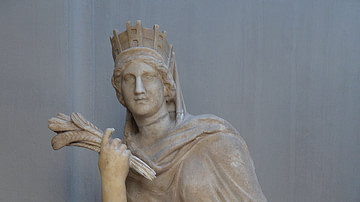
Tyche
In Greek mythology, Tyche is the goddess and personification of good luck, chance, and fortune. Tyche's popularity grew after the Classical period when many cities and officials across the Greek world and the Mediterranean adopted her as...

Definition
La Tène Culture
The La Tène culture (c. 450 - c. 50 BCE) is named after the site of that name on the northern shores of Lake Neuchâtel in Switzerland. It replaced the earlier Hallstatt culture (c. 1200 - c. 450 BCE) as the dominant culture of central Europe...

Article
Celtic Bronze Shields
The ancient Celts produced magnificent bronze shields in Iron Age Britain which were most likely for ceremonial purposes and display. Several fine examples have miraculously survived as evidence of the imagination, skill, and artistry of...

Article
Celtic Brooches - The Jewellery of the Ancient Celts
Ancient and medieval Celtic cultures produced many forms of jewellery, and one distinctive category is their brooches, fibulae, and pins. Without zips and buttons, brooches were used to close items of clothing, to create a pleasing or fashionable...

Image
Celtic God, Gundestrup Cauldron
A detail of the gilded silver Gundestrup Cauldron showing a Celtic deity. Likely 1st century BCE, produced in the Balkans but found in Denmark in 1891 CE. (National Museum of Denmark, Copenhagen)
Image
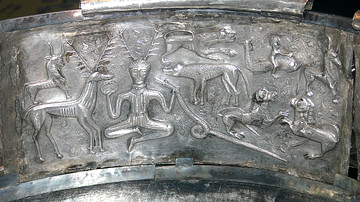
Horned-Figure Panel, Gundestrup Cauldron
A panel from the Gundestrup Cauldron showing a seated god with stag’s antlers, often identified as Cernunnos, an ancient Celtic god who represented nature, flora and fauna, and fertility. There is also a stag and deer on the left side and...

Image
Female Deity, Gundestrup Cauldron
A detail of the gilded silver Gundestrup Cauldron showing a female Celtic deity. Likely 1st century BCE, produced in the Balkans but found in Denmark in 1891 CE. (National Museum of Denmark, Copenhagen)
Image
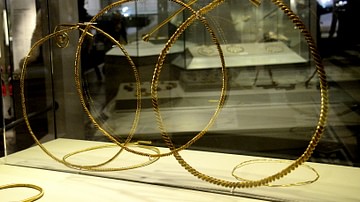
Gold Torcs from Ancient Ireland
Three gold torcs, found at Tipper South, Co. Kildare, Ireland, 1200-1000 BCE.
National Museum of Ireland-Archaeology, Dublin.

Image
Prince of Glauberg
The so-called "Prince of Glauberg" is a life-sized sandstone statue of a Celtic ruler from modern day Glauberg, Germany. The "Prince of Glauberg" is depicted with a mail tunic, a wooden shield and a sword, indicating his status as a warrior...
Image
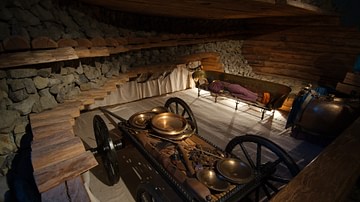
Reconstruction of the Hochdorf Chieftain's Grave
A reconstruction of an Iron Age grave from Hochdorf an der Enz in Baden-Württemberg, Germany. This burial mound is associated with the Hallstatt Culture, and the man interred is believed to have been a Celtic "prince" or chieftain. The grave...
