
Search
Did you mean: Taoism?
Remove Ads
Advertisement
Search Results

Definition
Venus Figurine
The term Venus figurine is used to describe the more than 200 small statuettes of voluptuous female figures that have been found at Upper Paleolithic sites across Europe and some parts of Asia. “When paleoanthropologists refer...

Image
Homo Habilis Reconstruction
Homo habilis reconstruction in the Museo de la Evolución Humana, Burgos, sculpture by Elisabeth Daynes (2010) based on the KNM-ER 1813 cranium (Koobi Fora, Kenya, dated 1.9 Ma).

Image
Oldowan Chopper
Chopper made from basalt by early humans between 1,8 and 2 million years ago. It belongs to the Oldowan stone tool industry, was found in Olduvai Gorge, Tanzania - the place the industry is named after. Its dimensions are length...

Image
Australopithecus Garhi Reconstruction
Reconstructed skull of Australopithecus garhi from fossils found in 1997 CE (Awash, Afar region). 2.5 million years old. Now found in Addis Ababa, National Museum of Ethiopia.
Image
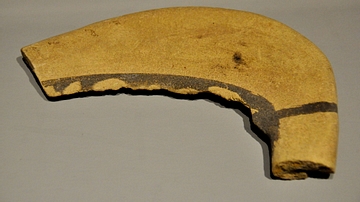
Clay Sickle
This cutting tool witnessed the beginning of agriculture. Ubaid period, 5th millennium BCE, Mesopotamia, Iraq. (The Sulaimaniya Museum, Iraq).

Image
Aurignacian Sites
Map showing sites and presence associated with the Aurignacian culture, usually attributed to the first modern humans who arrived in Europe around 45,000 years ago.

Image
Oldowan Chopper Tool
An example of an Oldowan stone chopper tool. From the Atlantic-Saharan region. (National Archaeological Museum, Madrid)

Image
Magdalenian Bone Sewing Needle
Flat bone sewing needle found at Gourdan Cave, Haute-Garonne, France. It belongs to the western European Magdalenian culture (c. 17,000 - c. 10,000 years ago) of the Late- or Upper Palaeolithic industry (c. 50,000/40,000...
Image
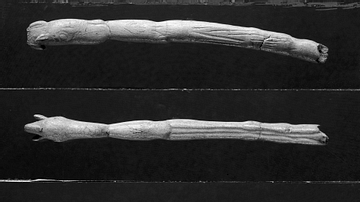
Magdalenian Bone Spear Thrower
Spear thrower made out of bone and decorated with a carving of a horse's head. It belongs to the western European Magdalenian culture (c. 17,000 - c. 10,000 years ago) of the Late- or Upper Palaeolithic industry (c...
Image
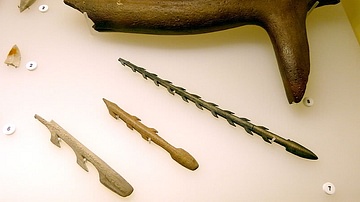
Mesolithic Harpoons & Lyngby Axe
Harpoons and Lyngby Axe (an axe made of antler) dated to around the 11th millennium BCE and belonging to the Mesolithic Age. It is on display at the Archaeological Museum of the state of Brandenburg in Germany.
