
Search
Remove Ads
Advertisement
Search Results

Definition
Azuchi-Momoyama Period
The Azuchi-Momoyama Period (Azuchi-Momoyama Jidai, aka Shokuho Period, 1568/73 - 1600 CE) was a brief but significant period of medieval Japan's history which saw the country unified after centuries of a weak central government and petty...

Definition
Yomi
Yomi, or Yomi-tsu-kuni, is the underworld of the Shinto religion, even if it forms no part of Shinto theology and appears only in ancient myths as told in the 8th-century CE Kojiki, notably the story of the creator gods Izanami and Izanagi...

Definition
Medieval Japan
The medieval period of Japan is considered by most historians to stretch from 1185 to 1603 CE. Stand out features of the period include the replacement of the aristocracy by the samurai class as the most powerful social group, the establishment...

Definition
Oda Nobunaga
Oda Nobunaga was the foremost military leader of Japan from 1568 to 1582. Nobunaga, along with his two immediate successors, Toyotomi Hideyoshi (1537-1598) and Tokugawa Ieyasu (1543-1616), is credited with unifying medieval Japan in the second...

Definition
Toyotomi Hideyoshi - Unifier of Japan
Toyotomi Hideyoshi (1537-1598) was a Japanese military leader who, along with his predecessor Oda Nobunaga (1534-1582) and his successor Tokugawa Ieyasu (1543-1616), is credited with unifying Japan in the 16th century. Hideyoshi rose from...

Definition
Emperor of Japan
The emperor of Japan is a position as the head of state which traditionally dates back to the 7th century BCE and the legendary figure of Emperor Jimmu (r. 660-585 BCE). Emperors came to be known as the Tenno or 'heavenly sovereign' in reference...

Definition
Samurai
The samurai (also bushi) were a class of warriors that arose in the 10th century in Japan and which performed military service until the 19th century. Elite and highly-trained soldiers adept at using both the bow and sword, the samurai were...

Definition
Portuguese Macao
Macao (Macau) is located on a peninsula in the estuary of the Pearl River delta in southeast China and it was a Portuguese colonial settlement from c. 1557 until 1999. Macao was a major trade hub of the Portuguese Empire and with its unique...

Definition
Kami
In the Shinto religion kami is an all-embracing term which signifies gods, spirits, deified mortals, ancestors, natural phenomena, and supernatural powers. All of these kami can influence people's everyday lives and so they are worshipped...
Definition
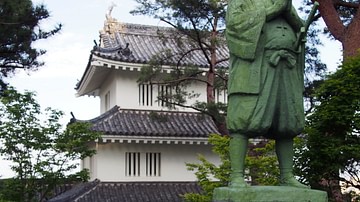
Shimabara Rebellion
The Shimabara Rebellion was a peasant uprising that occurred from 17 December 1637 to 15 April 1638 in Japan's southern island of Kyushu. Economic desperation, famine, and religious persecution led the peasants of the Shimabara peninsular...
