
Search
Remove Ads
Advertisement
Search Results

Definition
Tokugawa Iemitsu
Tokugawa Iemitsu (1604-1651) governed Japan as the third shogun of the Edo period. He implemented a number of important policies that not only consolidated his family's hold on power but also greatly impacted Japanese society for several...

Definition
Tokugawa Ieyasu
Tokugawa Ieyasu (1543-1616) was a Japanese military leader who reunified Japan at the beginning of the 17th century after a long period of civil war, known as the Warring States or Sengoku period. He created a new government controlled by...

Definition
Tokugawa Tsunayoshi
Tokugawa Tsunayoshi (1646-1709) governed Japan as the fifth shogun of the Edo period (1603-1876). He has often been ridiculed as the 'dog shogun' because of the laws he enacted to protect the lives of animals. Economically, however, the period...

Definition
Edo Period
The Edo period refers to the years from 1603 until 1868 when the Tokugawa family ruled Japan. The era is named after the city of Edo, modern-day Tokyo, where the Tokugawa shogunate had its government. It is also sometimes referred to as the...

Definition
Meiji Restoration
The Meiji Restoration was a political event that took place in Japan in 1868. In it, the Tokugawa family, a warrior clan that had ruled Japan for more than 260 years, was overthrown by a group of political activists who proclaimed that their...
Image
Tokugawa Tsunayoshi
Tokugawa Tsunayoshi (1646-1709), painting by Tosa Mitsuoki, 17th century.
Tokugawa Art Museum.
Image
Tokugawa Ieyasu
Portrait of Tokugawa Ieyasu (1543-1616) by Kanō Tan'yū, Edo period.
Osaka Castle, Main Tower.
Image
Tokugawa Iemitsu
Tokugawa Iemitsu (1604-1651).
Okayama Prefectural Museum.
Image
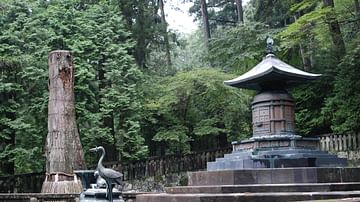
Tokugawa Ieyasu Mausoleum
Tokugawa Ieyasu Mausoleum, Nikko, Japan.
Image
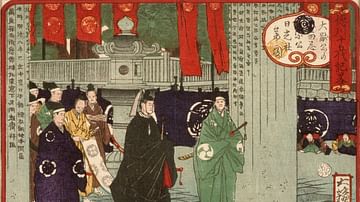
Tokugawa Tsunayoshi Visiting Nikkō Shrine
Tokugawa Tsunayoshi Visiting Nikkō Shrine, woodblook print by Tsukioka Yoshitoshi, 1875.
Los Angeles County Museum of Art.
