
Search
Did you mean: Thetis?
Remove Ads
Advertisement

 This answer was generated by
 Search Results

Article
Theatre of Dionysos Eleuthereus
The theatre of Dionysos Eleuthereus on the south slope of the acropolis of Athens was first built in the 6th century BCE. Modified and expanded over the centuries, it is the oldest Greek theatre and is the site where...

Article
Theatre of Marcellus
The theatre of Marcellus was the largest and most important theatre in Rome and completed in the late 1st century BCE during the reign of Augustus. The architecture of the theatre would become a standard feature of theatres...

Definition
Elizabethan Theatre
Elizabethan theatre, sometimes called English Renaissance theatre, refers to that style of performance plays which blossomed during the reign of Elizabeth I of England (r. 1558-1603) and which continued under her Stuart successors...

Image
Theatre of Delphi
The theatre of Delphi and the temple of Apollo below (4th century BCE). The capacity of the theatre was around 5,000 spectators.
Image
Theatre of Dionysos Eleuthereus, Athens
The 4th century stone version of the Theatre of Dionysos Eleuthereus, on the slopes of the acropolis of Athens. The theatre was orginally constructed in the 6th century BCE.
Image
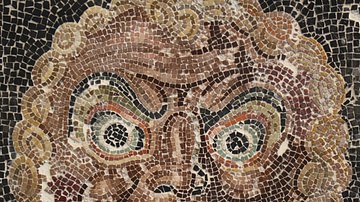
Theatre Mask Mosaic
A Roman theatre mask mosaic, 1st century BCE. From a private villa in the area of Villa Ruffinella, Rome. Palazzo Massimo, Rome.
Image
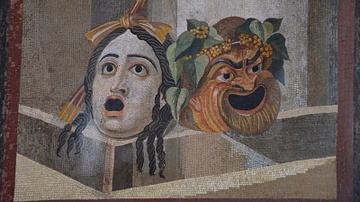
Theatre Masks, Roman Mosaic
Roman Mosaic depicting theatrical masks of Tragedy and Comedy, 2nd century CE, from Rome. (Palazzo Nuovo, Capitoline Museums)

Image
Theatre of Segesta
The 2nd century BCE theatre of Segesta, Sicily. The theatre had a capacity of up to 4,000 spectators.
Image
Theatre of Marcellus, Rome
The theatre of Marcellus, near the Capitoline Hill, Rome. Begun under Julius Caesar, the project was completed under Augustus and the theatre was named after the son of Octavia who, before his death in 23 BCE, was Augustus'...

Image
Theatre, Pompeii
The theatre of the Roman town of Pompeii was built in the 2nd century BCE and it was extensively renovated c. 79 BCE and repaired following the earthquake of 62 CE. At full capacity the theatre would have seated 5,000 spectators...
