
Search
Did you mean: Parthenon?
Remove Ads
Advertisement
Search Results

Article
The Temple of Apollo at Didyma
Located about 11 miles south of the ancient port city of Miletus on the western coast of modern-day Turkey, the Temple of Apollo at Didyma or Didymaion was the fourth largest temple in the ancient Greek world. The temple's oracle, second...

Article
The Delian League, Part 2: From Eurymedon to the Thirty Years Peace (465/4-445/4 BCE)
This text is part of an article series on the Delian League. The second phase of the Delian League's operations begins with the Hellenic victory over Mede forces at Eurymedon and ends with the Thirty Years Peace between Athens and Sparta...

Interview
Interview with Dr. Rita Roussos
Join World History Encyclopedia as they chat with Dr. Rita Roussos. Dr. Roussos is a native Athenian who has taught archaeology and art history at the American University of Athens and is a trained archaeologist who has worked on sites like...

Video
A Day in the Life of an Ancient Greek Architect - Mark Robinson
Follow Phidias (Pheidias), the chief builder for the Parthenon, as he supervises the construction of the new temple and faces charges of embezzlement. The year is 432 BCE. As dawn breaks over Athens, Phidias is already late for work. He is...

Video
The Development of Ancient Greek Architecture
Some of the most exceptional and distinctive buildings from the ancient world were crafted by the architects of ancient Greece and some of their structures like theatres, temples, and stadia became staple buildings in cities and towns from...

Image
Athens Acropolis
The Acropolis of Athens. Dominating the acropolis is the Parthenon, built between 447 and 432 BCE in the Age of Pericles, and dedicated to the city’s patron deity Athena.

Image
The Varvakeion Athena
A marble copy of the Athena Parthenos which stood in the Parthenon. Also known as the Varvakeion Athena, it is the best preserved such copy. 3rd century CE. (National Archaeological Museum, Athens)
Image
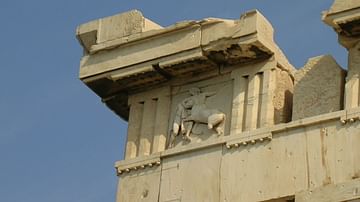
Entablature with Metope and Triglyphs
Entablature detail from the 5th century BCE Parthenon, Athens. Above the column capitals lies the abacus which supports the entablture. This latter element consists of the architrave, frieze and cornice. Here the frieze carries triglyphs...

Image
Panathenaic Procession
Block XLIV of the South Frieze of the Parthenon Sculptures. Attributed to Pheidias 438BC-432 BCE. Detail of a cow being led to sacrifice by four youths. The cow does not seem to be too happy about this. The two youths at right look back to...
Image
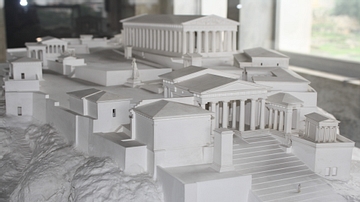
Model of the Athenian Acropolis
A model of the Athenian acropolis in the 5th century BCE. The monumental Propylaea gives access to the Parthenon (centre) and the Erechtheion (left side). (Agora Museum, Athens)
