
Search
Did you mean: Ull?
Remove Ads
Advertisement
Search Results
Definition
Angitia
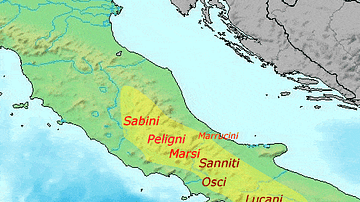
Angitia, which also appears epigraphically as Angita, Arigitia or Anguita, was a goddess among the pre-Roman Italic and Oscan-Umbrian peoples of central Italy and believed to have persisted as a domestic cult figure well into the Roman...

Definition
Denis Diderot
Denis Diderot (1713-1784) was a French author and philosopher known for his views which influenced the Enlightenment and his general editorship of the multi-volume Encyclopedia, often described as the 'Bible of the Enlightenment'...

Definition
Byzantine Emperor
The Byzantine Emperor ruled as an absolute monarch in an institution which lasted from the 4th to 15th century CE. Aided by ministers, high-ranking nobility, and key church figures, the emperor (and sometimes empress) was commander-in-chief...

Definition
John Hancock
John Hancock (1737-1793) was a merchant, politician, and Founding Father of the United States, who helped lead the Patriot movement during the American Revolution (1765-1789). He served as president of the Second Continental Congress...

Definition
Knap of Howar
The Knap of Howar is a Neolithic site on the island of Papa Westray in Orkney, Scotland. The name is Old Norse for `mound of mounds' or `large barrow'. The building preserved at the site is considered the oldest stone house in...

Definition
Cheyenne
The Cheyenne are a North American Native nation, originally from the Great Lakes region, who migrated to modern-day Minnesota and then to areas in North Dakota and further southwest. They are associated with the Plains Indians culture...

Definition
Aryan
Aryan is a designation originally meaning “civilized”, “noble”, or “free” without reference to any ethnicity. It was first applied as a self-identifying term by a migratory group of people from Central Asia later known as Indo-Iranians...

Definition
David Hume
David Hume (1711-1776) was a Scottish philosopher, writer, historian, and important figure in the Enlightenment. Hume presented a positive view of human nature but a sceptical view of religion's usefulness. His Treatise of Human Nature...

Definition
Ganesha
Ganesha (also Ganesa or Ganapati) is one of the most important gods in Hinduism. Ganesha is easily recognized with his elephant head and human body, representing the soul (atman) and the physical (maya). Ganesha is the patron of writers...
Definition
Parson's Cause
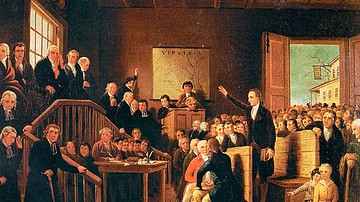
The Parson's Cause was a legal and political controversy that arose in the British colony of Virginia in the early 1760s. In response to the royal veto of the Two Penny Act, a policy passed by Virginia's House of Burgesses, a young...
