
Search
Did you mean: Fates?
Remove Ads
Advertisement
Search Results

Article
Lokasenna
The poem Lokasenna belongs to the Poetic Edda, a bulk of Old Norse poetry written down in Iceland in the 1200s but based on linguistic features dating back as far as the 900s. In this invaluable resource for Norse mythology, Lokasenna...

Article
A Praise Poem of Shulgi - A Celebration of an Ancient Famous Run
A Praise Poem of Shulgi (written circa 2020-2000 BCE) is an ancient Sumerian document celebrating the famous run of 200 miles (321.8 km) in one day made by the king Shulgi of Ur (reign 2094...

Article
The Death of Ur-Nammu - The Sumerian Vision of the Afterlife
The Death of Ur-Nammu is a Sumerian lament over the passing of the king Ur-Nammu (reign circa 2112-2094 BCE), founder of the Third Dynasty of Ur, who was killed in battle fighting the Gutians...
Article
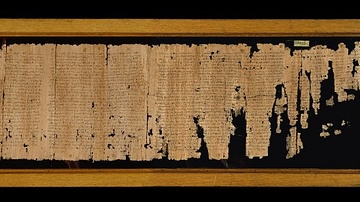
The Tales of Prince Setna
Among the most engaging and influential works from Egyptian literature are the stories in the cycle known as Setna I and Setna II or The Tales of Prince Setna. These are fictional works from the Late Period of Ancient...

Article
Warrior Women of the World of Ancient Macedon
The 8th November is celebrated as Archangels Day in Greece, but on that November day in 1977 CE something remarkable happened: an excavation team led by Professor Manolis Andronikos were roped down into...

Article
Hymn to Nungal - A Praise Song for the Sumerian Goddess of Prisons
The Hymn to Nungal (circa 1894-1595 BCE) is a Sumerian poem praising Nungal, the goddess of prisons and rehabilitation (also associated with the underworld), as well as the prison house...

Article
The Shield of Heracles: The Complete Poem
The Shield of Heracles (also known as The Shield of Herakles and, in the original, Aspis Herakleous) is a poem of 480 hexameter lines written by an unknown Greek poet in the style of Hesiod (lived 8th century...

Interview
Interview: Ariadne by Jennifer Saint
World History Encyclopedia is joined by Jennifer Saint, who is going to tell us all about her debut novel Ariadne. Kelly (WHE): Do you want to tell us a little bit about the book? Jennifer Saint (author): The...

Image
Ragnarök: The Complete Timeline - The End and Rebirth of the Norse World
Ragnarök, often translated as the “doom” or “fate of the gods”, is the climactic destruction and renewal of the cosmos in Norse mythology. Its best-known continuous account appears in...

Video
The Nine Realms of Norse Cosmology
The Norse people in their mythology divided their universe into nine realms with the world tree, Yggdrasil, in the centre. From Yggdrasil the nine realms of their cosmology either spread out from it or they stretched...
