
Search
Did you mean: Pandora?

 This answer was generated by
 Search Results
Image
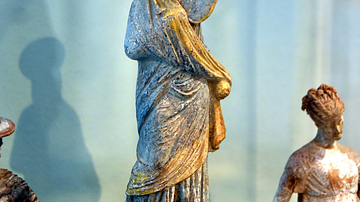
Tanagra Figurine
This small terracotta figurine is part of the so-called "Tanagra Figurines", which represent wealthy middle-class women. These statuettes served as votive and funerary objects, carrying a symbolic meaning connected with the status and role...
Image
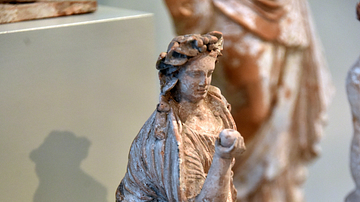
Tanagra Figurine of a Female
This small terracotta figurine is part of the so-called "Tanagra Figurines", which represent wealthy middle-class women. These statuettes served as votive and funerary objects, carrying a symbolic meaning connected with the status and role...

Definition
Hermes - The Messenger of the Olympian Gods
Hermes was the ancient Greek god of trade, wealth, luck, fertility, animal husbandry, sleep, language, thieves, and travel. One of the cleverest and most mischievous of the 12 Olympian gods, Hermes was their herald and messenger. In that...
Definition
Orion - The Hunter Who Became a Constellation
Orion was the great hunter of Greek mythology who was famed for his good looks and many love affairs. Either his assault of or admiration from Artemis resulted in the gods transforming the giant into a constellation. Referred to by such ancient...

Definition
Cimon
Cimon (c. 510 – 450 BCE) was an Athenian statesman and, as strategos, frequent commander of the Athenian fleet when the city was at the height of its power. He won military glory by defeating Spartan rival Pausanias and then the Persians...

Definition
The Pentecontaetia
The Pentecontaetia (Pentekontætia, πεντηκονταετία) or “the account of the fifty years” is a term first used by Thucydides to describe, in Book 1, Sections 89 to 117 (1.89-117) of his History of the Peloponnesian War, the period between the...

Definition
Antisthenes of Athens
Antisthenes of Athens (l. c. 445-365 BCE) was a Greek philosopher who founded the Cynic School. He was a follower of Socrates and appears in Plato's Phaedo as one of those present at Socrates' death. He is also one of the primary interlocutors...
Article
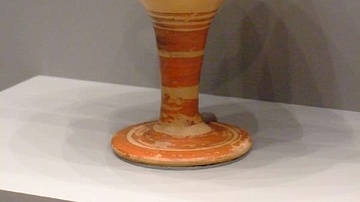
Mycenaean Pottery
The pottery of the Mycenaean civilization (1550-1050 BCE), although heavily influenced by the earlier Minoans based on Crete, nevertheless, added new pottery shapes to the existing range and achieved its own distinctive decorative style which...

Article
The Delian League, Part 2: From Eurymedon to the Thirty Years Peace (465/4-445/4 BCE)
This text is part of an article series on the Delian League. The second phase of the Delian League's operations begins with the Hellenic victory over Mede forces at Eurymedon and ends with the Thirty Years Peace between Athens and Sparta...

Article
The Delian League, Part 4: The Ten Years War (431/0-421/0 BCE)
This text is part of an article series on the Delian League. The fourth phase of the Delian League encompasses the first part of the Great Peloponnesian War, also referred to as the Ten Years War, sometimes called quite incorrectly The Archidamian...
