
Search
Remove Ads
Advertisement
Search Results

Definition
French Revolutionary Wars
The French Revolutionary Wars (1792-1802) were a series of conflicts that arose from the tensions surrounding the French Revolution (1789-1799). The wars were fought between Revolutionary France and several European powers...

Definition
Zakutu
Zakutu (l. c. 728 - c. 668 BCE) was the Akkadian name of Naqi’a, a secondary wife of Sennacherib of Assyria (r. 705-681 BCE). Though she was not Sennacherib's queen, she bore him a son, Esarhaddon, who would succeed him. She may have...

Definition
Battle of Neerwinden
The Battle of Neerwinden saw the major defeat of a French republican army by an allied force of Austrians and Dutch during the War of the First Coalition (1792-97), part of the broader French Revolutionary Wars (1792-1802...

Definition
Phaistos Disk
The Phaistos disk is a fired clay disk, probably of Minoan origin, measuring some 16cm in diameter and impressed on both sides with 242 symbols set in a spiral arrangement. As yet, this unique archaeological find remains an undeciphered...

Definition
French Republican Calendar
The French Republican calendar, also known as the French Revolutionary calendar, was created during the French Revolution (1789-1799) in an attempt to build a new society separate from the vestiges of the Ancien Régime...

Definition
Marcus Aurelius
Marcus Aurelius (r. 161 to 180 CE) was a Roman emperor best known as the last of the Five Good Emperors of Rome (following Nerva, Trajan, Hadrian, and Antoninus Pius) and as the author of the philosophical work Meditations. Although...
Definition
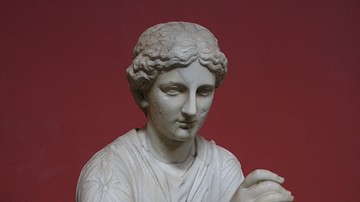
Calliope
Calliope (also spelt Kalliope) is the Muse of epic poetry and heroic song in Greek mythology. She is considered the leader of the Muses and the most honoured of them all. She is often represented in art with a tablet on her knee and...

Definition
Agamemnon (Play)
The play Agamemnon was written by one of the greatest Greek tragedians Aeschylus (c. 525 – 455 BCE), “Father of Greek Tragedy.” Older than both Sophocles and Euripides, he was the most popular and influential of all tragedians...

Definition
Indigo Revolt
The Indigo Revolt (aka Indigo Riots or Blue Mutiny) of 1859-60 in Bengal, India, involved indigo growers going on strike in protest at working conditions and pay. The subsequent violence was aimed at exploitative European plantation...
Definition
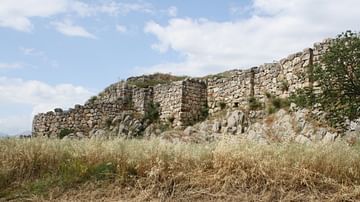
Tiryns
Located on the fertile Argolid plain, Tiryns lies between Nafplion and Argos in the eastern Peloponnese in Greece. The site has been inhabited since the Neolithic Age (7th-4th millennium BCE) but reached its greatest period of importance...
