
Search
Remove Ads
Advertisement
Search Results

Article
Magic in Ancient Greece
For the Greeks magic (mageia or goeteia) was a wide-ranging topic which involved spells and evil prayers (epoidai), curse tablets (katadesmoi), enhancing drugs and deadly poisons (pharmaka), amulets (periapta) and powerful love potions (philtra...

Article
Shamanism in Ancient Korea
Shamanism was widely practised in Korea from prehistoric times right up to the modern era. It is a belief system which originated in north-east Asian and Arctic cultures, and although the term shamanism has since acquired a wider meaning...

Article
The Monastic Movement: Origins & Purposes
In 313 CE, Constantine the Great (272 – 337 CE) ended the sporadic-yet-terrifying Christian persecutions under the Roman Empire with his “Edict of Milan,” and brought the Christian church under imperial protection. Not surprisingly, public...

Article
The Reforms of Peter the Great
Peter I of Russia (Peter the Great, l. 1672-1725) was the Tsar of Russia from 1682 to 1721 and the Emperor of Russia from 1721-1725. The lasting impression of Peter's long reign is the significant changes he brought to Russia due to his various...

Article
Drugs & Pharmaceuticals in Ancient Rome
Physicians in ancient Rome manufactured a wide variety of pharmaceuticals used to treat health concerns. Roman medicine was highly sophisticated, and Roman medical literature describes early antiseptics, narcotics, and anti-inflammatory medicines...

Article
Index of Prohibited Books - The Banned Books of the Catholic Church
The Index of Prohibited Books (Index Librorum Prohibitorum) was a list of written works condemned as heretical or injurious to the Christian faith by the Catholic Church at the Council of Trent in 1563. It remained in effect until 1966 when...
Article
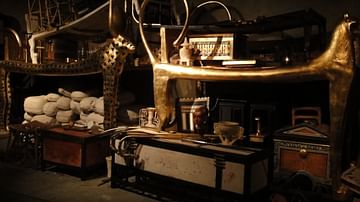
Grave Goods in Ancient Egypt
The concept of the afterlife changed in different eras of Egypt's very long history, but for the most part, it was imagined as a paradise where one lived eternally. To the Egyptians, their country was the most perfect place which had been...

Article
A Medieval Christmas
Christmas was one of the highlights of the medieval calendar, not only for the rich but also for the peasantry. For the longest holiday of the year, typically the full twelve days of Christmas, people stopped work, homes were decorated and...

Article
The Microscope & the Scientific Revolution
The microscope was one of the most significant inventions of the Scientific Revolution, opening up completely new and miniaturised worlds. The first microscopes were invented in the first quarter of the 17th century in the Netherlands, but...

Article
The Life of Diogenes of Sinope in Diogenes Laertius
Diogenes of Sinope (c. 404-323 BCE) was a Greek Cynic philosopher best known for holding a lantern to the faces of the citizens of Athens claiming he was searching for an honest man. He was most likely a student of the philosopher Antisthenes...
