
Search
Did you mean: Vulcan?
Remove Ads
Advertisement
Search Results

Definition
Pythia
The Pythia (or Oracle of Delphi) was the priestess who held court at Pytho, the sanctuary of the Delphinians, a sanctuary dedicated to the Greek god Apollo. Pythia were highly regarded, for it was believed that she channeled prophecies...
Definition
Lars Porsenna
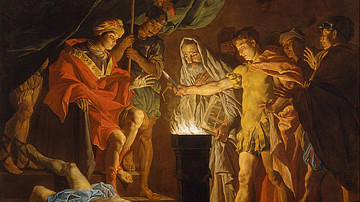
Lars Porsenna was the semi-legendary Etruscan king of Chiusi who famously attacked and probably occupied Rome c. 508 BCE when the city had just exiled its last king and was moving towards becoming a republic. His extravagant tomb...

Definition
Samos
Samos is a Greek island in the east Aegean, just off the coast of modern-day Turkey. It particularly flourished in the 6th century BCE and was famous in antiquity for its navy, wine, and important sanctuary to Hera. Samos was an active...

Definition
Odin
Odin (Old Norse: Óðinn) is the main god in Norse mythology. Described as an immensely wise, one-eyed old man, Odin has by far the most varied characteristics of any of the gods and is not only the deity to call upon when war was being...

Definition
Archaeology
Archaeology is a wide subject and definitions can vary, but broadly, it is the study of the culture and history of past peoples and their societies by uncovering and studying their material remains, i.e. tools, ruins, and pottery...
Definition
Phoenician Government
The governments of such Phoenician cities as Tyre, Sidon, and Byblos were led by hereditary monarchs throughout their history. Those individual cities typically acted autonomously from each other and only rarely did they form...

Definition
Hypatia of Alexandria
Hypatia of Alexandria (c. 370 - March 415) was a female philosopher and mathematician, born in Alexandria, Egypt possibly in 370 (although some scholars cite her birth as c. 350). Little is known of her life but her dramatic...

Definition
Phocion
Phocion (c. 402 – 318 BCE) was an Athenian statesman and military commander who, according to tradition, was made a general a staggering 45 times. A student of Plato and known as 'the Good', his political position was somewhat ambiguous...

Definition
Oppidum - The Hilltop Fort of the Celts
Celtic hilltop forts, often called oppida (sing. oppidum), after the Latin name given to larger settlements by the Romans, were built across Europe during the 2nd and 1st century BCE. Surrounded by a fortification...

Definition
Inca Warfare
The warfare of the Inca civilization was characterised by a high degree of mobility, large-scale engagements of hand-to-hand combat, and the establishment of a network of fortresses to protect an empire of over 10 million subjects...
