
Search
Remove Ads
Advertisement
Search Results

Definition
Tower of London
The Tower of London is a castle located in London alongside the River Thames which was first built by William the Conqueror from c. 1077 and significantly added to over the centuries. Often referred to in England as simply 'the...

Definition
The Gospels
The New Testament contains four gospels attributed to Matthew, Mark, Luke, and John. The four gospels are not biographies of Jesus, nor are they history as we define it. What each gospel attempted to do was write a theological explanation...

Definition
Jean-Baptiste Jourdan
Jean-Baptiste Jourdan (1762-1833) was a French general who held significant commands in the French Revolutionary Wars (1792-1802) and the Napoleonic Wars (1803-1815). He won a major victory for the French Republic at the Battle...

Definition
Library of Ashurbanipal
The Library of Ashurbanipal (7th century BCE) is the oldest known systematically organized library in the world, established in Nineveh by the Neo-Assyrian king Ashurbanipal (r. 668-627 BCE) to preserve the history and culture...

Definition
Operation Chastise - WWII's Dambuster Raid
Operation Chastise, the 'Dambusters' raid, was an attack by a squadron of RAF Lancaster bombers on the dams of the Ruhr basin in Germany in May 1943. Led by Squadron Leader Guy Gibson, the bombers breached...

Definition
Battle of the Little Bighorn
The Battle of the Little Bighorn (25-26 June 1876) is the most famous engagement of the Great Sioux War (1876-1877). Five companies of the 7th Cavalry under Lt. Colonel George Armstrong Custer (l. 1839-1876) were wiped...

Definition
Alexander the Great
Alexander III of Macedon, better known as Alexander the Great (l. 21 July 356 BCE – 10 or 11 June 323 BCE, r. 336-323 BCE), was the son of King Philip II of Macedon (r. 359-336 BCE) who became king upon his father's death in...

Definition
Mythology
Myths are a part of every culture in the world and are used to explain natural phenomena, where a people came from and how their civilization developed, and why things happen as they do. At their most basic level, myths comfort by...

Definition
Artemis
Artemis was the Greek goddess of hunting, wild nature, and chastity. Daughter of Zeus and sister of Apollo, Artemis was a patron of girls and young women, and a protectress during childbirth. Artemis was widely worshipped but her most...
Definition
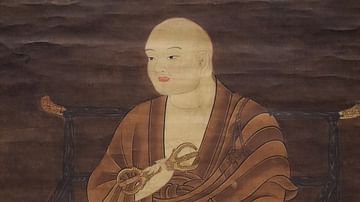
Kukai - Japan's Founder of Shingon Buddhism
Kukai or Kobo Daishi (774-835 CE) was a scholar, poet, and monk who founded Shingon Buddhism in Japan. The monk became the country's most important Buddhist saint and has been credited with all manner of minor...
