
Search
Remove Ads
Advertisement
Search Results

Definition
Moses
Moses (c. 1400 BCE) is considered one of the most important religious leaders in world history. He is claimed by the religions of Judaism, Christianity, Islam, and Bahai as an important prophet of God and the founder of monotheistic belief...

Definition
The Great Sphinx of Giza
The Great Sphinx of Giza is the most instantly recognizable statue associated with ancient Egypt and among the most famous in the world. The sculpture, of a recumbent lion with the head of an Egyptian king, was carved out...

Definition
House of Burgesses
The House of Burgesses (1619-1776 CE) was the first English representative government in North America, established in July 1619 CE, for the purpose of passing laws and maintaining order in the Jamestown Colony of Virginia and...

Definition
Belisarius
Flavius Belisarius (l. 505-565 CE) was born in Illyria (the western part of the Balkan Peninsula) to poor parents and rose to become one of the greatest generals, if not the greatest, of the Byzantine Empire. Belisarius is listed...

Article
Cheyenne Legends of the Buffalo
Two popular Cheyenne legends are the Origin of the Buffalo and How the Buffalo Hunt Began (also known as The Great Race), both dealing with the importance of the North American bison to the Cheyenne nation. Like others...
Article
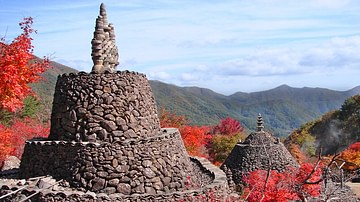
Shamanism in Ancient Korea
Shamanism was widely practised in Korea from prehistoric times right up to the modern era. It is a belief system which originated in north-east Asian and Arctic cultures, and although the term shamanism has since acquired...

Article
Observatories in the Scientific Revolution
The foundation of observatories during the Scientific Revolution (1500-1700) followed a process of evolution from entirely independent observatories operated by a single astronomer to private observatories...

Article
15 Complete Hyangga Songs from Ancient Korea
Hyangga was a form poetical 'country song,' distinct from contemporary Chinese songs, which were written in the Silla and Goryeo kingdoms of ancient Korea between the 7th and 10th century CE. The indigenous...

Interview
Interview: Shung Ye Museum of Formosan Aborigines
Indigenous peoples of Austronesian ancestry are the original inhabitants of Taiwan. Taiwanese indigenous peoples — formerly called Taiwanese aborigines, Formosan people, and Gaoshan (臺灣原住民族) — lived...

Article
The Origin of Satan
Satan, or the Devil, is one of the best-known characters in the Western traditions of Judaism, Christianity, and Islam. Surprisingly, this entity was a late-comer in the ancient world. Satan, as a totally evil being, is nowhere...
