
Search
Remove Ads
Advertisement
Search Results

Definition
Thera
Thera is the ancient name for both the island of Santorini in the Greek Cyclades and the name of the volcano which famously erupted on the island in the middle Bronze Age. The 17th century BCE eruption covered Akrotiri, the most important...

Definition
Battle of Actium
The Battle of Actium (2 September 31 BCE, fought in the Ionian Sea off Actium, Greece) was the decisive engagement of the civil war fought between Octavian Caesar (l. 63-14 CE, later known as Augustus, r. 27 BCE - 14 CE) and the...
Definition
Shinto
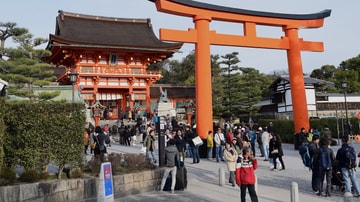
Shinto means 'way of the gods' and it is the oldest religion in Japan. Shinto's key concepts include purity, harmony, family respect, and subordination of the individual before the group. The faith has no founder or prophets and there...
Definition
Lasus of Hermione
Lasus of Hermione was a celebrated 6th century BCE Greek lyric poet and musician credited with making significant innovations in Greek music. The Suda (a large Byzantine record from the 10th century CE) dates his birth to the...

Definition
Moche Civilization
The Moche civilization (also known as the Mochica) flourished along the northern coast and valleys of ancient Peru, in particular, in the Chicama and Trujillo Valleys, between 1 CE and 800 CE. The Moche state spread to eventually...
Definition
Homo Floresiensis
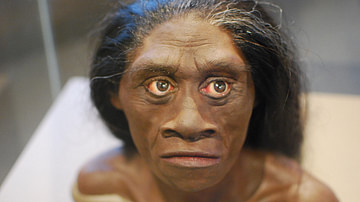
Homo floresiensis, nicknamed 'hobbit' because it only stood about 1 meter tall, is an extinct species of fossil human that lived on the island of Flores, Indonesia during the Pleistocene. Floresiensis is still shrouded in a fair...

Definition
Mycenae
Mycenae was a fortified late Bronze Age city located between two hills on the Argolid plain of the Peloponnese, Greece. The acropolis today dates from between the 14th and 13th century BCE when the Mycenaean civilization was at its peak...

Definition
Amber in Antiquity
Amber, the fossilised resin of trees, was used throughout the ancient world for jewellery and decorative objects. The main source was the Baltic region where amber, known to mineralogists as succinite, was washed up onto beaches...

Definition
John II Komnenos
John II Komnenos “the Handsome” was emperor of the Byzantine Empire from 1118 CE to 1143 CE. John, almost constantly on campaign throughout his reign, would continue the military successes of his father Alexios I with significant...

Definition
Colossus of Rhodes
The Colossus of Rhodes was a gigantic 33-metre-high bronze statue of the sun god Helios which stood by the harbour of that city from c. 280 BCE. Rhodes was then one of the most important trading ports in the ancient Mediterranean...
