
Search
Remove Ads
Advertisement
Search Results
Definition
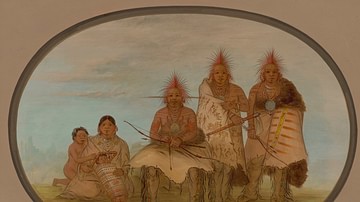
Pawnee
The Pawnee are a Native American nation of the Plains Indians culture originally from the region of modern Nebraska. Prior to the European colonization of the Americas, they were among the most powerful of the Plains Indian tribes numbering...

Definition
Sioux War Chief Gall (Eastman's Biography)
Gall (Phizi, l. c. 1840-1894) was a Hunkpapa Lakota Sioux war chief best known for his participation in the Battle of the Little Bighorn in June 1876. He was a close associate of Red Cloud (l. 1822-1909...

Definition
Trojan War
The Trojan War was fought between Greeks and the defenders of the city of Troy in Anatolia sometime in the late Bronze Age. The story has grabbed the imagination for millennia but a conflict between Mycenaeans and Hittites may well...

Definition
Ancient Indian Warfare
War was the chief means by which territory was annexed or rulers defeated in ancient India, which was divided into multiple kingdoms, republics and empires. Often one empire predominated or different empires co-existed...

Definition
Druid
Druids were a class of individuals in ancient Celtic cultures known for their great wisdom and knowledge of traditions. Not only priests who managed all religious rituals such as sacrifices (including humans), druids were able to give...

Definition
Mongol Warfare
The Mongols conquered vast swathes of Asia in the 13th and 14th century CE thanks to their fast light cavalry and excellent bowmen, but another significant contribution to their success was the adoption of their enemies' tactics...

Definition
Sioux Warrior Rain-in-the-Face (Eastman's Biography)
Rain-in-the-Face (Ite Omagazu, l. c. 1835-1905) was a Lakota Sioux warrior and war chief during Red Cloud's War (1866-1868) and at the Battle of the Little Bighorn (1876), after which he became famous...
Article
The Grand Strategy of Classical Sparta
In ancient Lacedaemon, as in all enduring political communities, there was a symbiotic relationship between the form of government chosen, the way of life that this form of government fostered, and the grand...

Definition
Critias
Critias (l. c. 460-403 BCE) was an Athenian politician, poet, and playwright, one of Socrates' followers, Plato's second cousin, a leading member of the Thirty Tyrants of Athens, and leader of the oligarchy they established. He is referenced...

Definition
Ancient Argos
Ancient Argos, located in the Peloponnese in Greece, was a major Mycenaean settlement in the Late Bronze Age (1700-1100 BCE) and remained important throughout the Greek, Hellenistic, and Roman periods until its destruction by the...
