
Search
Remove Ads
Advertisement
Search Results

Definition
Writing - The Preservation of Human Thought and Action
Writing is the physical manifestation of a spoken language. It is thought that human beings developed language circa 35,000 BCE as evidenced by cave paintings from the period of the Cro-Magnon Man (circa 50,000-30,000 BCE) which appear to...

Definition
U-Boat - Germany's Submarines of WWI & WWII
The U-boat, short for Unterseeboot (undersea boat), was the name for submarines used by the German Navy during the First World War (1914-18) and Second World War (1939-45). In the two Battles of the Atlantic, U-boats sank thousands of ships...

Definition
Junkers Ju 88
The Junkers Ju 88 was a two-engined medium bomber plane used by the German Air Force (Luftwaffe) throughout the Second World War (1939-45). Ju 88s were involved in the Battle of Britain and London Blitz as bombers, but this versatile aircraft...

Definition
Pyrrho
Pyrrho of Elis (l. c. 360 to c. 270 BCE) was a Greek skeptic philosopher credited with founding the school of Pyrrhonism which taught that one must resist making judgments or stating conclusions because sense perception did not correlate...

Definition
Ishtar
Ishtar (Inanna in Sumerian sources) is a primary Mesopotamian goddess closely associated with love and war. This powerful Mesopotamian goddess is the first known deity for which we have written evidence. While largely unknown in the modern...
Definition
Cahokia
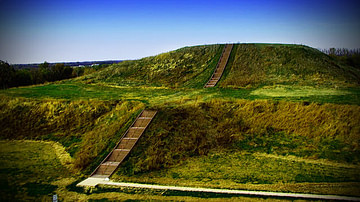
Cahokia is a modern-day historical park in Collinsville, Illinois, enclosing the site of the largest pre-Columbian city on the continent of North America. The original name of this city has been lost – Cahokia is a modern-day designation...

Definition
Aristarchus of Samos
Aristarchus of Samos (l. c. 310 - c. 230 BCE) was a Greek astronomer who first proposed a heliocentric model of the universe in which the sun, not the earth, was at the center. Although his theory was noted by other thinkers of his time...

Article
Slavery in Plantation Agriculture
The first plantations in the Americas of sugar cane, cocoa, tobacco, and cotton were maintained and harvested by African slaves controlled by European masters. When African slavery was largely abolished in the mid-1800s, the center of plantation...

Article
The Iberian Conquest of the Americas
European explorers began to probe the Western Hemisphere in the early 1500s, and they found to their utter amazement not only a huge landmass but also a world filled with several diverse and populous indigenous cultures. Among their most...

Article
Jesus & the Law of Moses
New Testament studies now place Jesus Christ within the parameters of Second Temple Judaism in the 1st century CE, attempting to go behind the layers of later Christian theology and philosophy (such as the trinity) to understand how his message...
