
Search
Remove Ads
Advertisement
Search Results

Article
The Armies of the Crusades
The armies of the Crusades (11th-15th centuries CE), which saw Christians and Muslims struggle for control of territories in the Middle East and elsewhere, could involve over 100,000 men on either side who came from all...

Definition
Greek Fire - The Byzantines' Seceret Weapon
Greek Fire was an incendiary weapon first used in Byzantine warfare in 678 CE. The napalm of ancient warfare, the highly flammable liquid was made of secret ingredients and used both in catapulted incendiary...

Article
Global Trade in the 13th Century
In the 13th century, astonishing quantities of spices and silk passed from the Far East to Europe. Exact amounts are not known, but spice popularity in both cuisine and medicine reached its historical peak during...

Definition
Edward the Black Prince
Edward of Woodstock (1330-1376 CE), better known as the Black Prince after his distinctive armour or martial reputation, was the eldest son of Edward III of England (r. 1327-1377 CE). Made the Prince of Wales in 1343 CE...

Definition
Golden Horde
The Golden Horde was the European appanage of the Mongol Empire (1206-1368 CE). Begun in earnest by Batu Khan in 1227 CE, the territory that would eventually become the Golden Horde came to encompass parts of Central Asia, much of...

Video
The Crusades: A Brief History of the Medieval Religious Wars
This video will give you a brief, yet detailed history of the Medieval religious wars known as the Crusades, beginning at the first crusade with the people's crusade led by Peter the Hermit...

Definition
Henry Clinton
Sir Henry Clinton (l. c. 1730-1795) was a British military officer who served as commander-in-chief of the British Army in the later stages of the American Revolutionary War (1775-1783). Having arrived in Boston in May 1775, he...

Image
Map of Medieval India, c. 1360
Medieval India around the mid-14th century (c. 1360) was characterized by political fragmentation, regional consolidation, and intense interaction between Islamic sultanates and long-established Indic polities. Following...
Definition
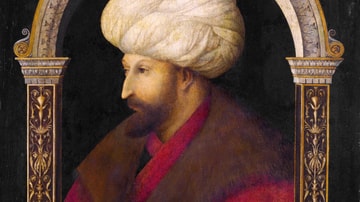
Mehmed II
Mehmed II (1432-1481 CE), also known as Mehmed the Conqueror, was the seventh and among the greatest sultans of the Ottoman Empire. His conquests consolidated Ottoman rule in Anatolia and the Balkans, and he most famously triumphed...

Video
Ancient Mesopotamian Warfare in Sumer and Akkad
Warfare was an essential part of the Akkadian Empire, especially under its conquering founder Sargon, and his grandson the god-king Naram-Sin. Their armies were the source of their power. But they were...
