
Search
Remove Ads
Advertisement
Search Results

Definition
Saladin
Saladin (1137-93) was the Muslim Sultan of Egypt and Syria (r. 1174-1193) who shocked the western world by defeating an army of the Christian Crusader states at the Battle of Hattin and then capturing Jerusalem in 1187. Saladin all but...

Definition
Sennacherib
Sennacherib (r. 705-681 BCE) was the second king of the Sargonid Dynasty of Assyria (founded by his father Sargon II, r. 722-705 BCE). He is one of the most famous Assyrian kings owing to the part he plays in narratives in the biblical...

Definition
Vercingetorix
Vercingetorix (82-46 BCE) was a Gallic chieftain who rallied the tribes of Gaul (modern-day France) to repel the Roman invasion of Julius Caesar in 52 BCE. His name means "Victor of a Hundred Battles" and was not his birth name...
Image
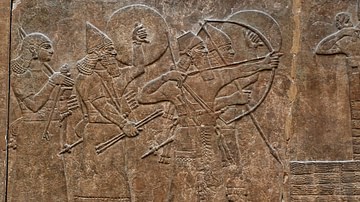
Assyrian Siege
This Assyrian relief from the North-West Palace in Kalhu (c. 865-860 BCE) shows King Ashurnasirpal advancing on an enemy city, protected by a shield-bearer. Ahead is a wheeled siege engine, which carries more archers and contains...

Article
Paul's Journeys and the Mediterranean Trade
Mediterranean trade increased exponentially at the turn of the first millennium. During Rome's zenith, goods of all sorts began to move in all directions. As a common traveler aboard merchant ships, Paul...
Article
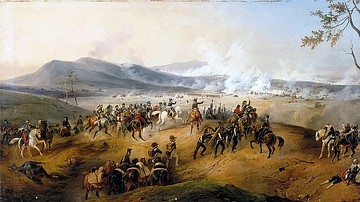
Battle of Castiglione
The Battle of Castiglione (5 August 1796) was one of the most important battles of Napoleon's Italian Campaign of 1796-97. After laying siege to the vital fortress of Mantua, General Napoleon Bonaparte and his Army of Italy...
Image
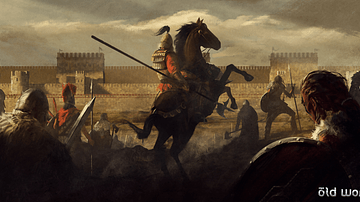
City Under Siege
Artist's impression of an army in front of a large city wall, most likely during Late Antiquity or the early Middle Ages. While this does not depict any specific event, the walls may represent the Theodosian Walls of Constantinople...

Definition
Alexander the Great
Alexander III of Macedon, better known as Alexander the Great (l. 21 July 356 BCE – 10 or 11 June 323 BCE, r. 336-323 BCE), was the son of King Philip II of Macedon (r. 359-336 BCE) who became king upon his father's death in...
Image
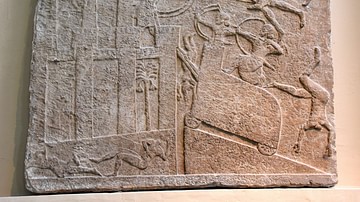
Babylonian City under Assyrian Siege
Assyrian relief showing a siege, from the Central Palace at Nimrud (ancient Kalhu), Mesopotamia, Iraq. Date palms indicate that the city, most of which was on an adjacent slab, was probably Babylonia. The Assyrians...
Definition
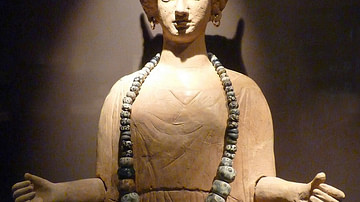
Carthaginian Religion
Carthage was founded by the Phoenician city of Tyre in the 9th century BCE, and along with many other cultural practices, the city adopted aspects of the religion of its founding fathers. Polytheistic in nature, such important...
