
Search
Remove Ads
Advertisement

 This answer was generated by
Search Results

Image
Siege of Tyre
Map of the Siege of Tyre, November 333 BC to August 332 BC.

Definition
Tyre
Tyre (in modern-day Lebanon) is one of the oldest cities in the world, dating back over 4,000 years, during which it has been inhabited almost continuously. It was one of the most important, and at times the dominant, city of Phoenicia...
Article
Alexander's Siege of Tyre, 332 BCE
After defeating Darius III at the battle of Issus in November 333 BCE, Alexander marched his army (about 35,000-40,000 strong) into Phoenicia, where he received the capitulation of Byblus and Sidon. Tyrian envoys...

Definition
Roman Siege Warfare
In ancient warfare open battles were the preferred mode of meeting the enemy, but sometimes, when defenders took a stand within their well-fortified city or military camp, siege warfare became a necessity, despite its high...

Definition
Phoenicia
Phoenicia was an ancient civilization composed of independent city-states located along the coast of the Mediterranean Sea stretching through what is now Syria, Lebanon and northern Israel. The Phoenicians were a great maritime people...

Definition
Melqart
Melqart (also Melkarth or Melicarthus) was an important Phoenician god and patron deity of the city of Tyre. Associated with the monarchy, sea, colonization, and commercial enterprise, both at home and abroad the god is a significant...

Article
The Siege of Acre, 1189-91 CE
The Siege of Acre, located on the northern coast of Israel, was the first major battle of the Third Crusade (1189-1192 CE). The protracted siege by a mixed force of European armies against the Muslim garrison and nearby...
Image
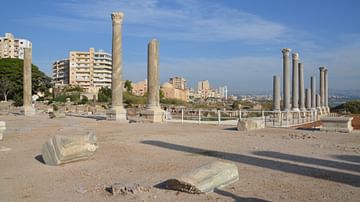
Tyre, Lebanon
The Al Mina excavation area of Tyre (Lebanon) showing the Palestra consisting of a 30 metre wide square area enclosed inside a granite colonnade.
Image
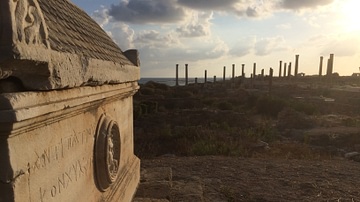
The Greek Ruins in Tyre
The ruins of the Greek colony of Tyre 'Týros', and the sarcophagus of Antipater (c. 399-319 BCE), modern-day Lebanon.
Image
Arch of Hadrian, Tyre
The impressive 20m-high monumental archway at Tyre (modern-day Lebanon) constructed in the 2nd century CE during the time of Hadrian who visited the city in 130 or 131 CE.
